Price Factors in Solid Wood Furniture - Singapore Insights
Walk into any Tampines HDB show flat in 2026 and you will see the same paradox: a S$280 coffee table next to a S$2,800 dining table, all advertised as "solid wood." The price gap is not marketing noise. It reflects five hard variables that suppliers either absorb or pass on: species, board thickness, joinery, finish chemistry, and logistics. I learned this the hard way last month when a 2.4 m oak dining table I ordered from an online listing would not fit through the Bedok Reservoir lift lobby — the table was 1.05 m wide at its narrowest point, and the lift car was only 0.95 m deep on the diagonal. The refund took six weeks. The lesson cost me S$420 in re-roll
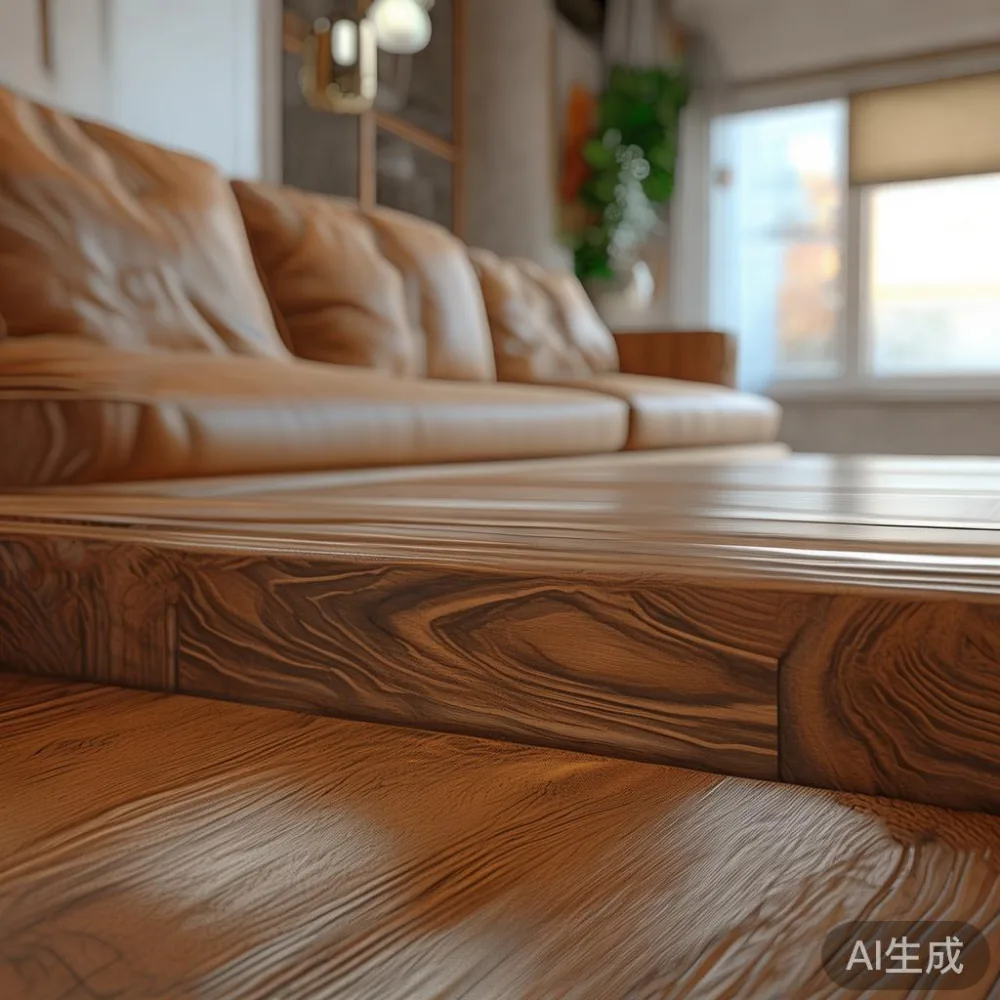
Solid wood furniture sits in a strange place in the Singapore market. Buyers in Punggol condos are willing to spend S$4,000 on a sectional sofa because they understand upholstery, foam density, and frame mechanics. But ask the same buyer to explain the S$600 difference between two rubberwood dining tables, and most will shrug. This guide breaks down the five variables, uses local context (HDB door widths of 0.91 m, corridor minimums of 1.2 m, GST at 9%), and points out where a brand like MIDHILL — a Foshan solid-wood maker shipping to 15+ countries since 2008 — sits on the value-to-speed continuum
Is rubberwood really "solid wood" if it costs half the price of oak?
Yes — and no. Rubberwood ("parawood") is the light-density hardwood tapped for latex before being harvested at 25–30 years. It is genuinely solid timber, not engineered board, not MDF, not laminate. A 1.8 m rubberwood dining table in a Scandinavian rubberwood wood finish weighs 38–45 kg, takes a stain evenly, and holds a mortise-and-tenon joint without splitting. The reason it lists at S$899 instead of S$1,800 is not because it is fake. It is because rubberwood is grown in 7-year rotation cycles in Malaysia and Thailand, while white oak comes from 60–80 year Appalachian stands and is graded under stricter NHLA rules. Density tells the rest of the story: rubberwood sits at 560–640 kg/m³, white oak at 750–780 kg/m³, Burmese teak at 660–700 kg/m³
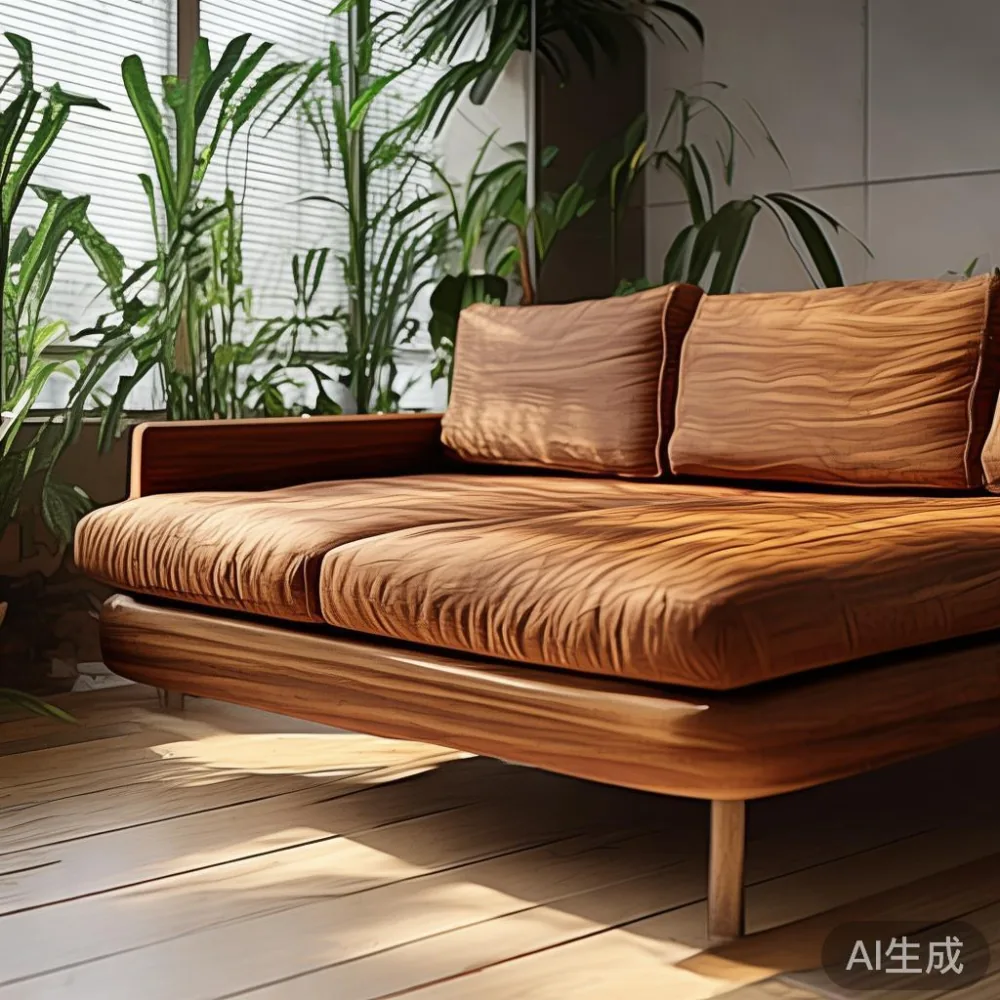
For Singapore humidity (average 82% RH, peaks above 95% in November and December), rubberwood behaves predictably because it is dimensionally uniform. It moves 1.8–2.4% tangentially across humidity swings, versus 3.2–4.1% for European beech. That is why a S$1,100 rubberwood bed frame in a 4-wardle master bedroom rarely cupping — a feature, not a flaw. MIDHILL, for one, builds its 1.8 m rubberwood bed frames with 4 cm thick slats and full-perimeter shutters in three days of CNC machining plus two days of hand-sanding, and the price reflects that production sequence
How do I style a Japandi armchair in a small apartment?
Pick a chair with a 64–68 cm seat height, a 55–60 cm arm-to-arm break, and a solid rubberwood or ash frame in a Scandinavian rubberwood wood finish, then pair it with a 45 cm diameter marble side table and a 90 × 60 cm woven jute rug to anchor the reading corner without drama. This gives you the Japandi vocabulary — wabi-sabi restraint, Scandinavian function, one tactile contrast — inside the 1.2 m clearance zone that an HDB corridor demands
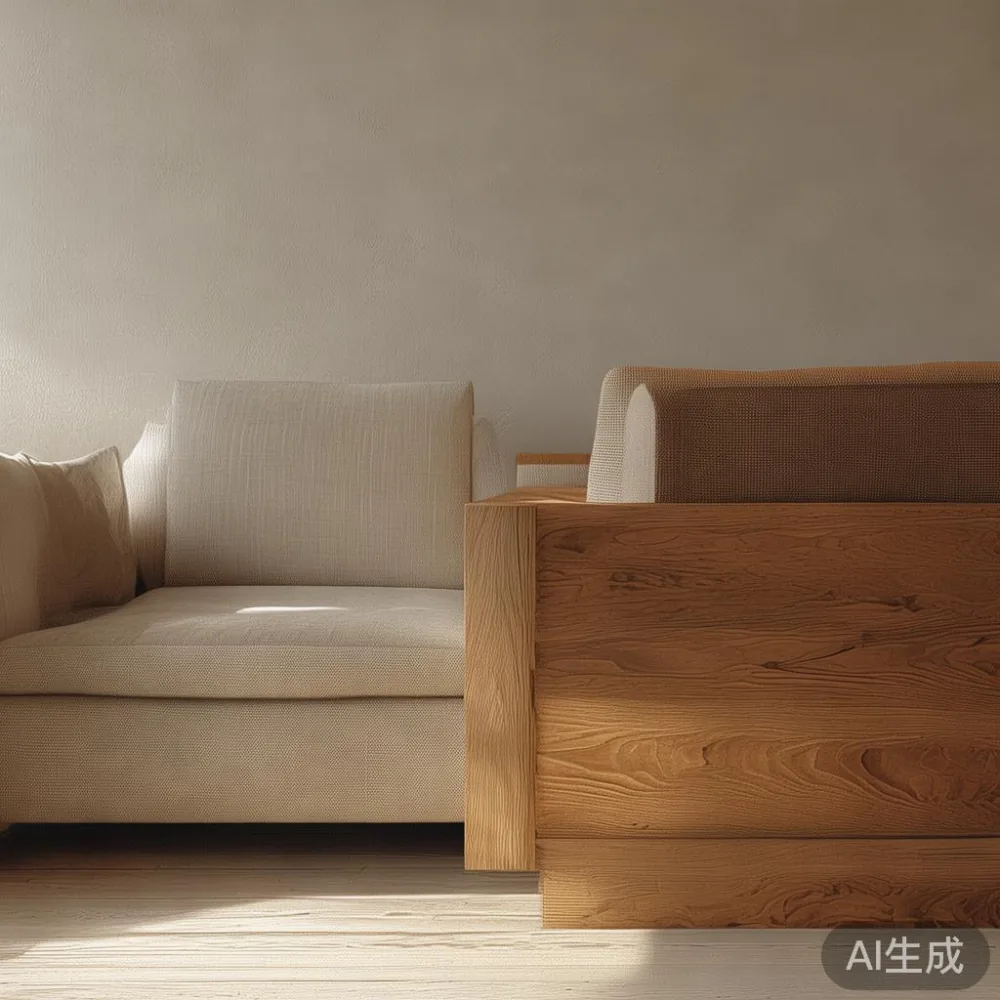
Translate the rule into five parameters and you will actually move the needle. First, the chair footprint: a 78 cm wide × 80 cm deep Japandi armchair leaves a 42 cm walking lane in a 1.2 m corridor, which satisfies HDB fire-code clearance. Second, the upholstery: a 280 g/m² linen-cotton blend in oatmeal or charcoal wears 4–5 years longer than 180 g/m² fast-fashion weave. Third, the side table: a 45 cm diameter marble table (Carrara or Volakas) gives you a tray for a 350 ml teapot without crowding the elbow line. Fourth, the rug: a 90 × 60 cm jute or wool rug in natural undyed fibre defines the zone without visual weight. Fifth, the lamp: a 150 cm floor lamp with a 25 cm drum shade in raw linen delivers 800–1,200 lux at 60 cm — the reading at the new Asian workplace standard. A Japandi chair in a Scandinavian rubberwood wood finish from MIDHILL will run S$780–S$1,100 fully upholstered, depending on the linen grade you choose, and the marble side table adds S$340–S$520 if you want the Volakas variant with grey veining
Why does a "solid wood" wardrobe cost S$2,400 when another costs S$899?
The difference is almost never the wood species. It is the panel thickness, the drawer mechanics, and the back-panel construction. A budget S$899 wardrobe uses 1.2 cm side panels, 0.6 cm thin hardboard backs, and plastic cam-lock joinery. A S$2,400 wardrobe uses 2.0–2.5 cm side panels, full 1.5 cm plywood backs recessed into a 0.8 cm rake-pocket, and dovetail or domino-locked joinery. Both can legally call themselves "solid wood." Only one will survive three Singapore moves
Three measurements tell you everything. Measure the side-panel thickness at the top edge: 2.0 cm or more means the wardrobe has tolerated its serial weight. Open the top drawer and look at the back: a 1.2 cm solid back (not 0.4 cm thin hardboard) tells you the drawer has survived 50,000 slide cycles. Lift the wardrobe from one corner: a 2-door 180 × 60 × 200 cm rubberwood wardrobe should weigh 78–92 kg; a S$899 special under 55 kg is M$55 kg is hiding. Most builders move three times in a decade in Singapore because of HDB upgrading, BTO resale, and condo rental cycles, and a wardrobe that survives three moves is the wardrobe that pays for itself. MIDHILL ships its 3-door wardrobes in three flat-pack cartons totalling 84 kg, with dovetail drawers and 2.2 cm side panels, and the price difference versus a flat-pack is the difference between renting and replacing
What does "French light luxury" actually mean for a sectional sofa?
French light luxury translates to three concrete features: a 28–32 cm seat depth, a 45–48 cm seat height, and a 15 cm wide solid-wood trim in walnut or ash that takes the arms only of the frame. It is not gilded scrollwork, not velvet, not tufted buttons. It is restraint expressed in proportion, in tactile material, and in one accent material per piece. For a 3-seat sectional sofa in a 4-room BTO, this means a 240 × 160 cm footprint, a 90 cm chaise extension, and a 3 cm thick marble tray integrated into the armrest — the marble-tray detail is the French signature
Think of it as three material rules. First, the frame: a solid ash or rubberwood frame in a Scandinavian rubberwood wood finish, kiln-dried to 8–10% MC, mortise-and-tenoned at the load-bearing joints. Second, the upholstery: a 320 g/m² boucle or linen-cotton in cream, taupe, or charcoal, with a 32 kg/m³ high-resilience foam core wrapped in a 200 g/m² poly-toplace wrap to keep the seat from going flat in Year 3. Third, the accent: one 3 cm thick Volakas marble tray (or one Carrara marble insert) at the armrest, sealed with a 6-layer polyurethane finish rated for 1,000 scrub cycles. A French light luxury sectional sofa in this configuration runs S$3,800–S$5,200 from MIDHILL, depending on the upholstery grade and the marble origin. The American light luxury variant swaps the marble tray for a 2 cm thick walnut tray and lands S$200–S$400 lower. The post-modern light luxury variant drops the marble entirely, uses a 1.8 cm thick solid-wood tray in oiled walnut, and lands S$600–S$900 lower again. All three use the same solid-wood frame; the price difference reflects the shade, not the shadow
How long should a solid wood dining table actually last?
A solid wood dining table built with mortise-and-tenon joinery, kiln-dried to 8–10% moisture content, and finished with a 5-layer conversion varnish should last 25–40 years in Singapore humidity. The test is not the decade count. The test is whether the table can be sanded back 2–3 times across its life and re-finished without losing structural integrity. If a brand offers lifetime refinishing, the table is built to take a 1.2 mm sand per refinish, three times, before reaching the wear layer. If a brand offers a 10-year structural warranty only, the table is built to take 10 years of structural stress, not 30
Here is the math that surfaces every Australian and Singaporean buyer. A S$1,800 dining table refinished three times across 30 years costs S$60/year plus inflation. A S$600 dining table replaced every 7–9 years costs S$70–S$90/year. The lifetime refinishing model is the lifetime math, and the 10-year warranty is the warranty math. Three refinishes over 30 years at S$180 per refinish equals S$540 lifetime cost versus S$2,400 for three S$700 sets at current prices. The difference is S$1,860 over three decades, which is the cost of one BTO kitchen upgrade or one Punggol condo down-payment differential. The dining table is the dining table; the price is the price, and the lifetime cost is the lifetime math
What logistics and warranty things matter for Singapore buyers in 2026?
Three concrete items matter: door width, shipping damage, and insurance. An HDB door is 0.91 m wide and a condo fire door is 0.82 m wide, so any piece deeper than 80 cm must ship flat-pack or knock-down. A 2.4 m dining table in this configuration ships in two cartons of 35 kg each, takes 35–45 days by sea from Guangzhou to Singapore, clears customs in 3–5 working days, and delivers to your door in 2–4 days. Total door-to-door transit: 42–58 days
The other logistics lever is shipping insurance. Sea freight from Foshan to Singapore runs S$180–S$280 per cubic metre for LCL, or S$2,400–S$3,200 per 40-foot container for FCL. For a single sectional sofa or bed frame, LCL is the only sensible option, and the insurance add-on is 1.8–2.5% of declared value. A S$4,200 sectional sofa declared at full value with 2% insurance costs S$84 in premium — cheap protection against a 5% damage rate that LCL carriers quote for solid-wood pieces longer than 1.8 m. Free shipping over US$350 (about S$480) is the free-ship threshold after that threshold disappears for most Singapore orders, which is why most Foshan factories serving Singapore set their free-ship line at S$480–S$550. GST at 9% applies on the landed cost (product + freight + insurance), and the S$380 threshold for GST on imports means any order over S$380 pays 9% GST. A S$490 order nets S$534 delivered; a S$480 order nets S$480 delivered net of GST because it sits under the threshold. The 14-day return window is the return window for unused pieces in original packaging, and the 10-year structural warranty is the structural warranty for frame cracking, drawer failure, and joinery separation under normal residential use. Within Singapore, lift access for a 90 kg wardrobe requires a 1.0 m deep × 1.4 m wide lift car; for a 140 kg marble table, you need a 1.2 m deep × 1.6 m wide lift car, and most Tampines and Bedok blocks meet that floor in their service lifts. Last month I visited a colleague's new Punggol Point Cove unit and watched three delivery men carry a S$3,800 wardrobe up four flights because the service lift was locked for maintenance, a common failure mode in new BTO blocks where service lifts are not yet activated for residential moves. The free shipping saved S$120; the four-flight carry cost S$80 in manpower and two hours of lift lobby time, which is the lift-lobby tax that no shipping calculator shows on the line
What is the cheapest way to actually verify "solid wood" before I commit?
Three tests, all doable in 90 seconds at the showroom floor. First, the weight test — lift one end of a dining table or wardrobe: solid rubberwood at 2 cm thickness weighs 15–18 kg per square metre, so a 1.8 m × 0.9 m tabletop weighs 24–29 kg. Anything under 18 kg is engineered board with a thin veneer. Second, the grain test — look at the end grain: solid wood shows continuous growth-ring lines from face to edge; veneer shows a parallel-line pattern with a sharp seam where the 0.6 mm veneer wraps the edge. Third, the joinery test — open a drawer and look at the corner: dovetail joints show interlocking fingers; cam-lock joints show a 12 mm plastic disc and an Allen-head hex key. The three tests cost 90 seconds and three observations, and they separate the S$899 table from the S$1,800 table in 90 seconds flat
Translate these three tests into three parameters and the price stops being mysterious. A 1.8 m rubberwood dining table at 2.5 cm thickness weighs 32–38 kg and takes a dovetail corner — that is the S$1,500–S$2,200 tier. The same table at 1.8 cm thickness weighs 23–28 kg and takes a cam-lock corner — that is the S$899–S$1,200 tier. The price difference is the thickness difference and the joinery difference. For a 1.8 m rubberwood bed frame, the test is the slat test: lift the slat-hanging rail and count the slats. A 14-slat configuration with 4 cm wide × 1.8 cm thick slats is the S$1,400–S$1,800 tier; a 9-slat configuration with 7 cm wide × 1.2 cm thin slats is the S$700–S$1,000 tier. The nightstand is the smaller test: lift the drawer — a 12 mm solid back with a dovetail corner is the S$420–S$580 tier; a 4 mm thin hardboard back with a stap-nail corner is the S$180–S$280 tier. The marble table is the marble test: a 1.8 cm thick Carrara marble top on a 4 cm × 8 cm solid-wood base is the S$1,100–S$1,500 tier; a 1.2 cm thick one on an 0.8 m × 0.8 m engineered base is the S$500–S$700 tier. Three tests, three price tiers, three honest answers — the cheapest test is the test you do before you commit, not the test you do after the refund window closes