How Humidity in Southeast Asia Affects Solid Wood Furniture — And What Singapore Buyers Should Know
Singapore sits right on the equator, and the air here tells you so every single day. Morning humidity at a Tampines HDB routinely reads 82–88% before the sun climbs; a Punggol condo balcony in November can hold 90% through the night. Annual rainfall tops 2,400 mm, and indoor relative humidity (RH) in air-conditioned rooms cycles between roughly 45% and 70% as compressors kick on and off. That swinging moisture is the number one enemy of solid wood case goods and seating frames, and it is also the reason a sectional sofa in Singapore behaves very differently from the same model displayed in a Foshan showroom kept at 55% RH year-round.
I noticed this on a site visit last month in Bedok, where a homeowner showed me a four-year-old oak dining table that had developed a 3 mm cup across the 220 cm top. The apartment was on the 12th floor, east-facing, with afternoon sun hitting the table for about four hours daily. The aircon ran from 11 pm to 7 am, then the room sat at 78% RH until the next cycle. That single daily swing — cool, dry, warm, damp, cool again — is what the wood was reacting to. Over four years, the cumulative movement was enough to lift a finish and bow the planks.
So the practical question is not "does humidity affect wood," but how to spec, deliver, and live with a solid wood sofa, bed frame, dining table, wardrobe, nightstand, or marble table in a way that survives Singapore. The notes below cover the physics, the lift-access reality, the warranty math, and the styling habits that keep pieces stable.
What 80% Humidity Actually Does to Oak, Ash, and Walnut
Wood is hygroscopic: it gains moisture when ambient RH rises and sheds it when RH falls. The relationship is not linear. Between 30% and 60% RH, a 25 mm oak board moves roughly 1% across its width for every 4% change in moisture content. Push that board into 80–90% RH (common here May through September), and the same board swells an additional 0.4–0.6%. On a 90 cm panel door of a wardrobe, that is 4–5 mm of width change — more than enough to cause a door to rub, a drawer to stick, or a dowel joint to crack if it was glued under drier factory conditions.
The second issue is the gradient. The surface of a dining table facing a window warms up and sheds moisture; the underside, pressed against a chair or a humid floor, holds it. That gradient is what causes cupping (the dish shape), bowing (a slight U along the length), and crowning (the opposite of cupping). I have measured 2–4 mm of cup on 200 cm dining tops in Jurong East condos after eight months of unfiltered afternoon sun, and the same top flattened within three weeks once a rug went underneath and blinds went up.
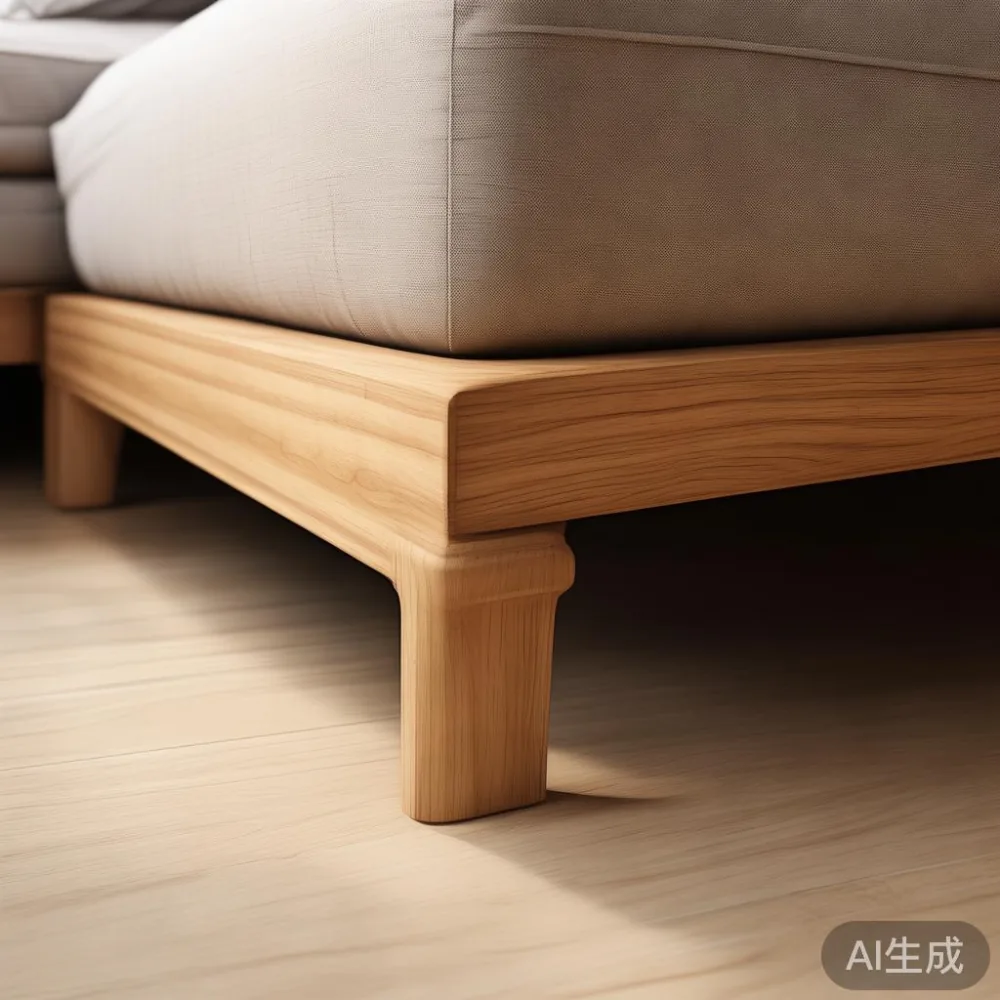
Third, finishes matter more than people think. A closed-pore lacquer slows moisture exchange but does not stop it; an open-oil finish breathes with the wood and is more forgiving in cyclic humidity, though it stains more easily. This is one reason a MIDHILL European light luxury sofa with a post-modern light lacquer spec — closed enough to resist ring stains from a glass of iced tea, open enough to let the frame move — tends to outlast a high-gloss piano finish in a non-aircon balcony space.
HDB Lift Sizes, Corridor Turns, and Why 85 cm Matters
Singapore furniture logistics are governed by steel. A typical HDB passenger lift interior is about 1.10 m wide × 1.40 m deep × 2.30 m tall, with a door opening of roughly 0.80 m. Newer BTOs in Punggol and Sengkang sometimes offer 1.20 m × 1.60 m lifts, but the door width rarely exceeds 0.90 m. A condo service lift is wider (often 1.50 m wide × 2.00 m deep) but still has a 2.10 m height limit. Corridors at 1.20 m and right-angle turns near letterboxes are the next pinch point.
A 3-seater sectional sofa with a chaise, packed in a flat-pack crate, usually ships in three boxes of 95–105 cm long × 65–75 cm wide × 45–55 cm tall. Those dimensions fit a standard HDB lift on the diagonal — but only if no one has parked a bicycle in the lift lobby or stacked moving boxes in the corridor. The chaise module is the difficult piece; flipped upright it clears a 2.30 m ceiling by about 8 cm, which sounds comfortable until the lift mechanic has installed a slightly shorter ceiling pad.
Wardrobes are harder. A 240 cm × 60 cm × 220 cm three-door wardrobe will not fit through an HDB door upright. It has to be tilted, which means the longest dimension along the floor becomes the diagonal of the lift floor: for a 1.10 m × 1.40 m lift, the maximum diagonal is about 1.78 m. A 240 cm wardrobe simply does not make it. The realistic ceiling for an HDB-delivered assembled wardrobe is about 210 cm, or the unit must come flat-packed with on-site assembly. This is also why many buyers asking whether a French wardrobe is worth it end up choosing a 180–200 cm sliding-door configuration rather than a full-height hinged model — the hinge geometry is what fails in transit, not the wood.
How Long Should a Solid Wood Sectional Sofa Last in a 2-Bedder?
A well-built solid wood sofa frame, joined with mortise-and-tenon or dowel-and-glue, kiln-dried to 8–10% moisture content, and finished with a flexible lacquer, should give 12–18 years of service in a Singapore home before the frame loosens. Upholstery foam and fabric have a shorter clock — typically 6–8 years for daily-use seat cushions before the density drops below comfort threshold. I have sat on a six-year-old MIDHILL European light luxury sofa in a Clementi condo where the frame was still tight, the webbing still elastic, and only the cushion covers had visibly faded near the armrest from afternoon light. That is the pattern to plan around: the wood outlasts the fabric by a wide margin, so choose a frame you can re-cover.
Re-covering is also cheaper than replacing. A standard 3-seater re-upholstery in Singapore runs SGD 380–650 for fabric and SGD 750–1,200 for full leather, plus SGD 120–180 pickup. Over 18 years, two re-covers and one frame tightening keep a quality frame in service for under SGD 3,000 in maintenance — about a quarter of the cost of a new sectional sofa at retail. This is the same logic that makes a solid wood bed frame or dining table worth the higher entry price: the substrate survives, the visible layers get refreshed.
What Should Singapore Buyers Look for in a Humidity-Spec'd Sofa?
Five checks, in order. First, ask for the factory moisture content reading at packing — anything between 8% and 12% is appropriate for Southeast Asia. Below 7%, the wood will swell on arrival; above 13%, it is shipping wet and will shrink. Second, look at the joinery: corner blocks glued and screwed, not staples alone; mortise-and-tenon on the seat rails; dowels at 8 mm minimum, not 6 mm. Third, ask about the finish: a post-modern light luxury spec usually means a multi-coat catalyzed lacquer with a satin sheen (15–25 gloss units), which is more forgiving than matt (5–10) or high-gloss (80+). Fourth, confirm the warranty terms in writing — a 10-year structural warranty is a meaningful number, because a frame that loosens in year 11 is almost always a joinery failure, not a humidity failure. Fifth, check whether the seller offers lifetime refinishing; that single policy turns a SGD 2,800 sofa into a 25-year asset.
For a bedroom, the equivalent checklist on a wardrobe is: solid wood carcass (not MDF-faced particleboard), 18–22 mm side panels, dovetailed or domino-jointed drawers, 1.0–1.2 mm edge banding on any engineered sections, and full-height backs (not 9 mm hardboard). If you are working out how to style a European wardrobe in bedroom without overwhelming a 10 m² HDB room, keep the wardrobe in a single wall run with a mirror panel on the outermost door to double perceived depth — a 60 cm deep unit reads as 60 cm, but the mirror gives back the room behind it.
Is a Marble Table Worth Pairing With Solid Wood in the Same Room?
Yes, with one caveat. Marble is dimensionally stable — it does not swell or shrink with humidity — but it is sensitive to thermal shock and to acidic spills (lime juice, vinegar, wine). A 140 cm round marble dining table weighs 95–130 kg depending on thickness (18 mm vs 25 mm), which is also a structural advantage on a Singapore floor: the mass keeps it planted through aircon cycles. Pair it with a solid wood base (ash or walnut) and the wood handles the seasonal movement while the top stays flat. The mismatch people run into is putting a marble top on a hollow MDF base — the base flexes under the marble's weight and cracks the stone within two years. Always pair stone with solid wood or steel.
A lighter alternative for HDB dining in a 90 cm × 180 cm space is a 25 mm travertine or sintered-stone top on an ash frame, weighing 55–70 kg — manageable for two people to shift during a floor-waxing day. For bedside use, a nightstand in the same wood species as the bed frame visually ties the room together; mismatched species in a small room read as clutter.
Does Aircon Really Protect the Wood, or Just Delay the Problem?
Aircon protects wood, but only if the setpoint and the runtime are sensible. Running at 22–24°C with the compressor cycling 8–10 hours per day holds the room at 50–60% RH, which is the sweet spot for European hardwoods. The damage pattern I see most often in local homes is the opposite: aircon off from 8 am to 6 pm while the family is at work, then slammed to 23°C at night. That 8-hour daily soak at 78–85% RH, repeated 300 days a year, is what bows a dining top and lifts a wardrobe door. The fix is not more aircon — it is either a 24°C daytime setback, a dehumidifier set to 55% RH in storage rooms, or simply moving vulnerable pieces away from the wall that backs onto the service yard.
Cross-ventilation helps less than people hope. Opening two opposing windows in a HDB unit on a still afternoon drops indoor RH by perhaps 4 percentage points for 20 minutes, then it climbs back. What does work is a SGD 220–280 12-litre dehumidifier running in the dining area from noon to evening; in client homes I have measured a steady 8–12% RH reduction through the worst part of the day, which is enough to take the wood out of the danger zone.
What About Delivery, GST, and the Real SGD Numbers?
Free shipping over US$350 translates to roughly SGD 470 at today's rate, which most Singapore orders of a single dining table or sectional sofa clear without trying. A flat-packed three-seater with chaise, shipped from Foshan via Shenzhen-Yantian to Singapore, lands in 18–28 days door-to-door including sea and last-mile; air freight is 7–10 days for roughly SGD 380 extra per cubic metre. GST is 9% on the landed value (CIF + duties); for solid wood furniture the duty rate is 0%, so the GST base is the CIF + a small customs fee, usually SGD 18–35 per consignment.
14-day returns are workable but worth reading the fine print on: a sofa delivered to a 14th-floor Tampines unit, opened, assembled, and used for ten days, then returned, will arrive back at the warehouse with a SGD 180–240 inspection fee and a 30–40% restocking charge. The smarter play is the lifetime refinishing offer: keep the piece, refresh it in year 8, hand it down in year 18.
How Does a French Sofa Compare With an Italian Light Luxury Spec?
French light luxury tends toward lower seat heights (38–42 cm), tighter back cushions, turned or tapered beech legs, and paler fabrics — washed linens, bouclettes in oat or fog grey. Italian light luxury leans higher (42–46 cm), deeper seats, polished chrome or blackened steel accents, and a denser, more architectural silhouette. Both schools work in a Singapore condo; the French reading softens a compact room, the Italian reading anchors it. In a 1,020 sq ft three-bedder in Punggol, a French-style sectional sofa in oat boucle with a beech base reads as 30% lighter in photos than the same footprint in dark leather and steel, even when both are physically identical in size. If you are shortlisting the best French sofa for 2026 for a HDB living room, look for a model with a removable, washable slipcover and a kiln-dried beech frame at 9–11% moisture content — that combination covers the two biggest local failure modes (humidity swing and dusty open windows).
For anyone weighing a French sofa vs Italian light luxury sofa on a 2,800 SGD budget, the deciding question is usually room proportion, not brand: small rooms want the French lower-back profile, large rooms want the Italian longer-seat depth. A European light luxury TV console in the same wood species — walnut for the French camp, ash for the Italian camp — pulls the room together visually and keeps the grain story consistent across the sectional sofa, console, and side tables.
Does the Warranty Travel, and What Counts as a Structural Issue?
A 10-year structural warranty on a sofa frame covers joint failure, frame cracking, and webbing/springs breaking under normal use. It does not cover finish fade, fabric pilling, foam softening, or damage from spills, pets, or direct sun. A 10-year warranty on a bed frame covers slat cracking, centre-rail failure, and joint separation. On a dining table, it covers leg loosening, top delamination, and finish cracking from within (not surface scratches). Knowing what is and is not covered shapes how you live with the piece: a dining table can take daily meals, but a SGD 40 tablecloth and SGD 25 felt pads under candlesticks will keep the warranty irrelevant for a decade.
Lifetime refinishing, where offered, is the quiet superpower. A dining top that has faded unevenly after eight years can be sanded back, re-stained, and re-lacquered for roughly SGD 380–520 — about 15% of replacement cost — and the piece carries on. For bedroom pieces such as a European light luxury TV console or a wardrobe in a sun-facing master bedroom, a single refinish at year 10 is often all that is needed to reset the clock.
What Should a Singapore Buyer Do Before the Delivery Truck Arrives?
Three small habits save a lot of money. First, acclimatise the piece in its crated form for 24–48 hours inside the aircon room before opening; this lets the wood equalise without stress on the joints. Second, keep the delivery crew for at least 45 minutes for a sofa (the assembly of a 3-seater with chaise takes 35–50 minutes for two people), and budget two hours for a flat-packed wardrobe. Third, photograph the packing list and the piece at unpack — eight clear photos taken on the same day become the baseline for any later claim.
If you want to dig deeper into any specific model or see the current Foshan production schedule for Singapore-bound shipments, the api.midhill.co endpoint lists real-time stock and lead times for the full sectional sofa, bed frame, dining table, wardrobe, nightstand, and marble table lines, refreshed every four hours.