How to Match Furniture to a Warm Minimal Interior Without Losing the Cosiness
Warm minimalism sits in a quiet corner of the design world. It strips a room back to the bones, then warms those bones with grain, texture, and a few well-chosen solids. In a Singapore HDB flat in Tampines, a five-room condo in Punggol, or a landed patio in Bukit Timah, the trick is the same: pick pieces that earn their footprint, not ones that fill it. I spent last month walking through three showrooms and two completed apartments with a colleague who had just signed the keys on her 1,066 sqft Bedok resale. We measured corridors, timed the lift, and argued over wood tones for two weekends. The notes from those trips shaped everything below.

Start with the palette: warm whites, oat tones, and one real wood
Warm minimalism is not the cold, gallery-style minimalism you see in catalogue shots. It runs on a tight palette: warm white walls (think Dulux Natural White, around S$52 for 4 litres), an oat or sand mid-tone for soft furnishings, and a single anchor of natural timber. In Singapore's year-round 28–32°C humidity, very pale ash and light oak photograph beautifully but can read as washed out under flat LED strips, so we pulled a sample of white oak and a sample of beech into a Tampines corridor at 7pm and compared. The oak held warmth; the beech went pink. Oak won.
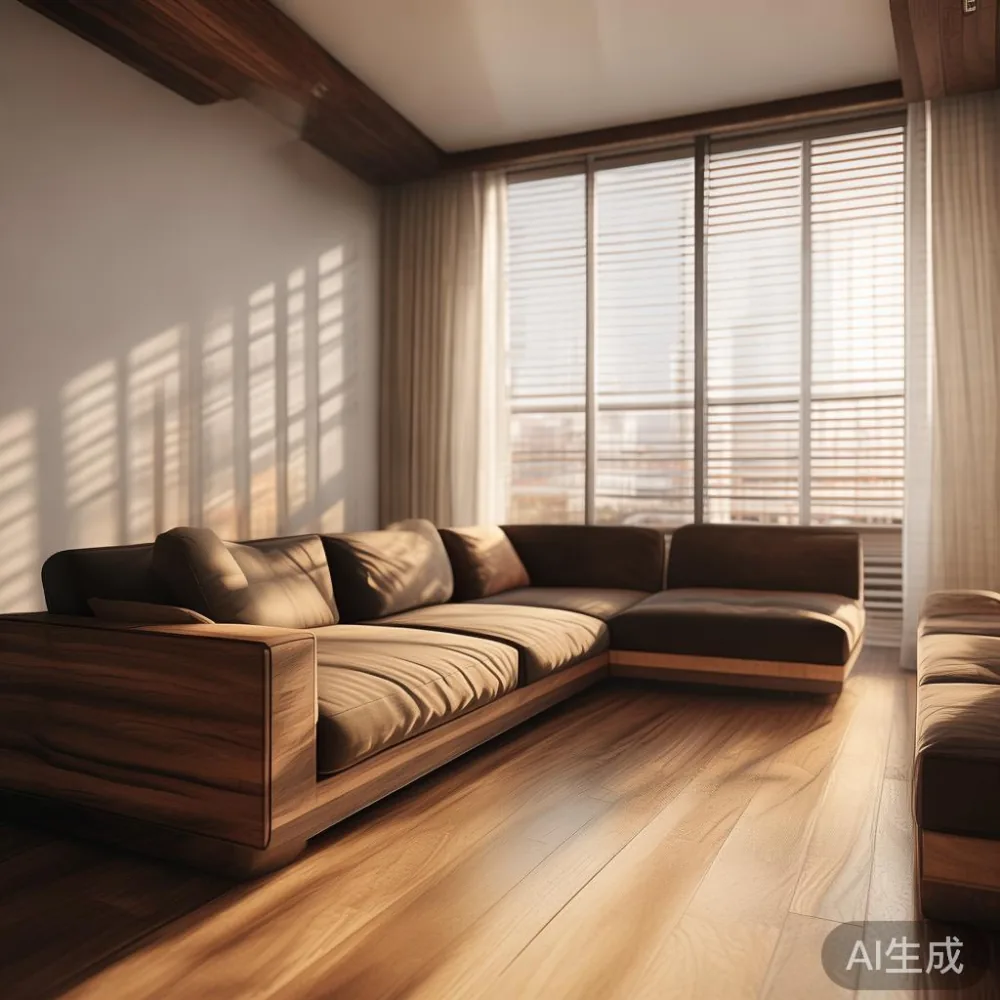
For a sectional sofa in this palette, the trick is fabric, not leather. A boucle or linen-blend in ecru or putty keeps the room reading soft. MIDHILL's solid wood sectional sofas are built on hardwood frames and finished in low-sheen natural oil, which lets the timber breathe in our humidity rather than crack under it. The frame's grain becomes a quiet piece of decoration against the neutral fabric, which is exactly the rhythm warm minimalism wants.
Measure the lift, the corridor, and the doorway before you fall in love
Singapore HDB corridor widths are commonly 1.2 m to 1.4 m. Most standard lift cabins measure 1.1 m wide by 1.4 m deep, with a diagonal of roughly 1.78 m. A three-seat sectional sofa with a chaise can easily run 280 cm long and 95 cm deep, so the chaise usually has to come off the frame for the move. Solid wood furniture makers that ship regionally will split frames for transit; ask whether the chaise reattaches with brackets or with dowels. Dowels hold longer.
Doorways in resale flats tend to be 80–85 cm wide. A dining table over 90 cm wide will not pass through without tilting, and even then the legs need to come off. We learned this the hard way when a 200 cm solid wood dining table arrived for a Punggol condo and refused to clear the bedroom door. The fix was a flip-top extension model that splits into two 100 cm halves. Plan for this in advance: a 160 cm to 200 cm extendable solid wood dining table, with legs that unbolt in under three minutes, will save you a S$120 redelivery fee and a Saturday afternoon.
Wardrobes are the next stress test. A two-door wardrobe at 120 cm wide by 60 cm deep usually passes; a three-door at 180 cm often does not, especially around the tight turn from corridor to bedroom in older BTOs. Measure the corner radius, not just the corridor. Bring a tape to the showroom. Bring a torpedo level too, because floors in older Singapore blocks run 1–2 cm out across a 3 m span, and that affects wardrobe plinth alignment more than people expect.
How do you keep a sectional sofa from dominating a small HDB living room?
Choose a low-profile L-shape on a plinth rather than tall legs, keep the chaise on the shorter side (around 150 cm, not 180 cm), and pull it at least 12 cm away from the wall so the room does not feel like a doll's house. In a 1,066 sqft Bedok layout with a 3.2 m living room wall, a 245 cm by 165 cm sectional leaves about 75 cm of walkway past the coffee table, which is the minimum a grown adult needs without brushing the marble table edge on the way to the kitchen.
Fabric weight matters here. A 480 g/m² boucle feels grounded; a 280 g/m² linen feels floaty. For warm minimal interiors, mid-weight wins. Pair the sectional with a 120 cm by 60 cm marble table in travertine or warm Carrara, raised on slim black steel legs so the heavy stone does not visually crush the room. Keep the marble table height 5 cm below the sectional seat, around 38 cm total, so the eye reads the composition as layered rather than stacked.
What is the difference between Nordic bed and modern furniture?
Nordic bed design uses pale woods such as ash, pine, and birch, lighter stains that keep the timber close to its natural colour, slim turned or tapered legs, and visible joinery in the spirit of mid-century Danish work; modern furniture, sometimes called post-modern or contemporary, often uses darker walnut and oak tones, mixed materials like metal and glass, and bolder geometric silhouettes. In short, Nordic bed pieces whisper warmth through pale grain, while modern furniture speaks in stronger contrasts and heavier volumes.
In a warm minimal interior, both directions work, but they lead to different rooms. A Nordic-style solid wood bed frame in white oak at 150 cm by 200 cm, with a low headboard around 90 cm tall, will disappear into an oat-coloured bedroom and let the bedding do the work. A modern bed frame in smoked walnut with a 110 cm channel-tufted headboard becomes the focal point, and the walls should stay quiet. For Singapore's humidity, ask about kiln-drying schedules: a good solid wood bed frame should be dried to 8–10% moisture content so it does not cup when the December rain rolls through.
Pair the bed with a nightstand that does not match it exactly. A round travertine nightstand beside a rectangular oak bed reads as composed, not matchy. Heights should align within 2 cm. A solid wood nightstand at 48 cm tall beside a 50 cm mattress top gives the bedside lamp a sensible perch.
Solid wood, veneer, or marble? Reading the price tag without getting fooled
Solid wood costs more because the volume of timber is real. A solid wood dining table for six in white oak or ash typically lands between S$2,400 and S$4,200 in Singapore, depending on whether the top is a single slab or two boards book-matched. A veneered table with an MDF core looks identical on day one, but at 85% relative humidity the seams lift within 18 months. Ask the salesperson to show you the underside. If it is sealed with a different laminate from the top, it is engineered.
Marble tables are a different conversation. A 120 cm round travertine table can weigh 78 kg; a 140 cm by 70 cm rectangular version runs 92 kg. Two deliverymen, not one, and a trolley with rubber wheels. Sealing is non-negotiable in Singapore: an unsealed travertine will mark within the first coffee spill. Re-seal every 18 months at around S$90 per visit, or learn to do it yourself with a fluorine-based impregnator.
For wardrobes, the same logic applies. A solid wood wardrobe at 180 cm by 60 cm by 210 cm, made from 18 mm thick panels, weighs 95–110 kg. A hollow-core version of the same size weighs 55 kg and feels different the moment you open the door. The hinge sag on hollow doors shows up by year three. Solid wood holds the hinge line true for ten years and beyond, which is why makers who stand behind their work offer 10-year structural warranties on wardrobe frames.
How often should you refinish solid wood, and what does lifetime refinishing actually cover?
For a solid wood dining table or bed frame used daily, plan on a light refinish every 5 to 7 years and a full sand-and-recoat every 12 to 15 years. In Singapore, UV exposure through unfiltered afternoon windows is the main culprit, so a UV-filtering film on west-facing glass at around S$18 per square metre pays for itself in kept colour. Lifetime refinishing, when offered by a maker, usually means the workshop will collect, strip, re-stain to the original tone, and re-oil or re-lacquer for a fixed labour fee plus materials. Budget S$280 to S$480 per dining table refinish, depending on size.
MIDHILL has built this service into how they work with customers in the region, including a Singapore client whose 2014 oak dining table returned from a recent refinish looking closer to new than to its mid-life photo. It is one of those quiet benefits that does not show up in the showroom but matters when you are ten years in. The same applies to solid wood bed frames and nightstands: a re-oil every few years keeps the grain open and the colour honest.
Is light luxury a real style, or just a marketing phrase?
Light luxury is a real movement, and it has three recognisable branches. French light luxury leans on cream bouclé, brushed brass, walnut veneers, and curved silhouettes inspired by 1940s Parisian salons; American light luxury uses wider tracks, deeper seats, slightly looser tailoring, and oak or ash tones pulled toward caramel; post-modern light luxury mixes sculptural forms with mixed metals and travertine or warm marble, often with one or two statement pieces that read more like sculpture than furniture. All three can sit inside a warm minimal interior if you keep the count of statement pieces to one per room.
For a sectional sofa, the French light luxury direction is the easiest to integrate, because the curved arms and softer profiles already match warm minimal proportions. American light luxury suits the wider HDB living room layouts in Punggol and Sengkang, where the extra 20 cm of seat depth actually gets used. Post-modern light luxury works best in a condo with a slightly higher ceiling, around 3.0 m or more, so the sculptural marble table has room to be seen.
Reading warranties, returns, and shipping without doing the math wrong
Singapore buyers should read three numbers before paying a deposit. The first is the structural warranty: 10 years on frames is a fair benchmark for solid wood sofas, bed frames, dining tables, and wardrobes. Anything shorter, and the maker is betting that you will not claim. The second is the returns window: 14 days is the comfortable minimum for an online order, because GST-inclusive pricing, delivery lead time, and lift access are three variables that can each go wrong. The third is shipping: free shipping above a set order value (often US$350 when the maker is a regional exporter) saves roughly S$80 to S$180 per order on a sectional sofa, and free lift-level delivery beats doorstep delivery in almost every HDB scenario.
GST is now 9% in Singapore, so a S$3,200 dining table lands at S$3,488 inclusive. Some makers absorb GST on orders above a threshold; ask before checkout. Delivery lead times of 28 to 45 days are normal for made-to-order solid wood, and 7 to 14 days for in-stock pieces. Plan a sectional sofa delivery for a weekend, so the room can be cleared, the old sofa moved to the lift lobby for the bulky refuse removal service (free for HDB residents, bookable through the My HDBPage app), and the new sectional positioned in a single morning.
Putting it together: a Bedok living room, item by item
Imagine the 1,066 sqft Bedok flat my colleague moved into. Walls in warm white. Floors in 12 mm engineered oak over a 3 mm acoustic underlay, which keeps the upstairs neighbour's footsteps down by roughly 18 dB. A 245 cm by 165 cm solid wood sectional sofa in oat boucle, paired with a 120 cm by 60 cm travertine marble table on slim black legs. A 180 cm by 90 cm solid wood dining table that extends to 220 cm for the in-laws, with six solid wood dining chairs in beech or ash. Two wardrobes in white oak, 150 cm and 120 cm, fitted side by side along the bedroom wall. A solid wood bed frame in white oak at 180 cm by 200 cm with a low headboard, two round travertine nightstands, and linen bedding in oat and clay.
The room is warm, minimal, and liveable. It will age well because the materials are honest. A solid wood dining table gains character over fifteen years rather than losing it. A sectional sofa on a hardwood frame can be reupholstered twice in its life, each time for around S$600 to S$900, which is far cheaper than buying new. A marble table will mark slightly, then stop, and the patina becomes part of the room.
One last note on a phrase that came up while sourcing dining chairs: a French dining chair saudi arabia showed up in a supplier's catalogue, which is a reminder that the same warm minimal language travels from a Lyon bistro to a Riyadh apartment to a Tampines HDB. The pieces look similar because the proportions are honest and the materials are real. That is the whole game: honest proportions, real materials, and a measured plan for the lift on delivery day.