Sectional Sofa Buying in Singapore: Sizes, Costs and Layout Ideas
Compare sectional sofas for HDB and condo homes, with clear dimensions, prices, delivery advice, fabric choices and practical layout guidance.
- How big is a sectional sofa before you order it?
- Will an L-shaped sectional sofa fit in a typical HDB living room?
- Which sectional sofa material works best in Singapore’s humidity?
- How much should I budget for a sectional sofa in Singapore?
- How do I avoid a sofa that is too deep for my living room?
- Is a modular sectional sofa easier to deliver and rearrange?
- How long should assembly and delivery take in a Singapore home?
- What should I compare when choosing a sectional sofa for a condo?
- How do I check sofa quality before paying the balance?
How big is a sectional sofa before you order it?
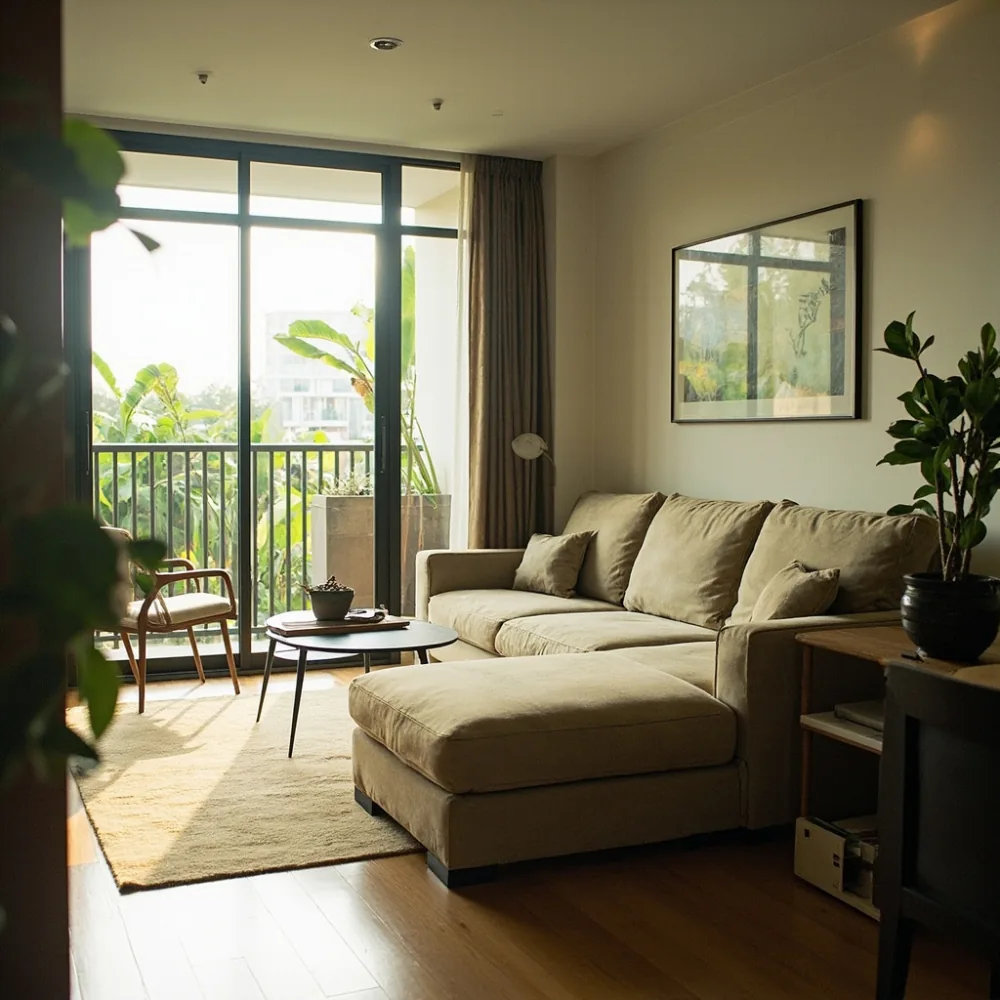
Measure the wall, doors and intended seating
Compare three practical sizes
I measure before I browse, because a sectional sofa can look modest online and become the dominant object in a Singapore living room. Start with the wall or alcove where it will sit, then check the delivery route. For most HDB living rooms, I would begin with a 180–220 cm wide model. A condo with an open-plan living and dining area can support a 240–280 cm arrangement, provided it does not block the balcony or walkway.
The useful comparison is not the product photograph but the packed dimensions. Measure your lift, corridor turns, staircase, lobby clearance and front door. Leave at least 5 cm of maneuvering room where the delivery crew must angle the sofa. Wide boxed seating can weigh 75–130 kg, and a longer chaise may be shipped as two or three modules.
- Compact HDB: 180–220 cm wide, about 85–100 kg
- Standard family layout: 230–260 cm wide, about 95–125 kg
- Open-plan condo: 270–300 cm wide, about 115–150 kg
| Configuration | Typical dimensions | Weight | Indicative price |
|---|---|---|---|
| Two-seat with ottoman | 180 × 95 × 82 cm | 75–90 kg | SGD 1,200–2,400 |
| Three-seat with chaise | 240 × 160 × 82 cm | 95–125 kg | SGD 2,200–4,800 |
| U-shaped modular set | 280 × 210 × 82 cm | 130–165 kg | SGD 4,000–8,500 |
Those are planning ranges, not fixed specifications. Before paying, ask for the exact assembled dimensions, module weights, packaging size and carton count. That one check prevents the classic mistake of buying a good sofa that cannot enter the home.
Will an L-shaped sectional sofa fit in a typical HDB living room?
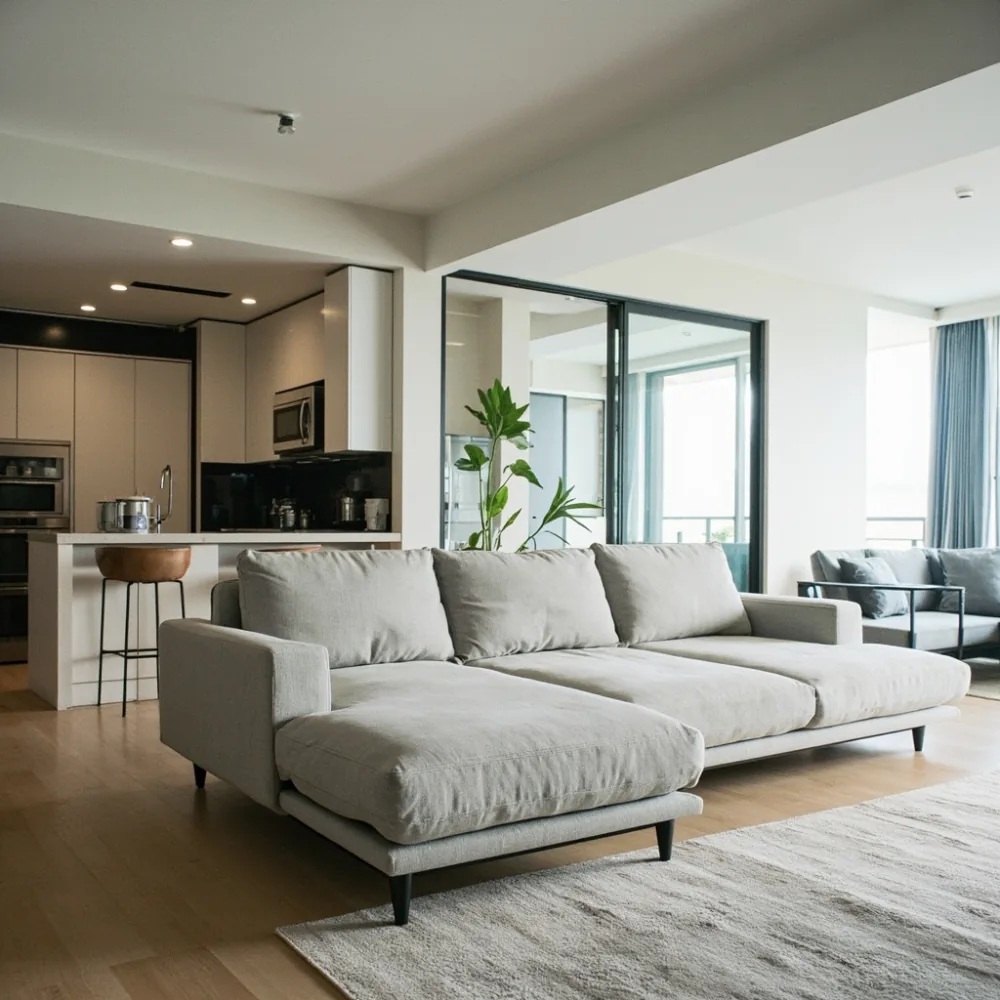
Account for the television and dining zone
Keep the main passage open
A three-seat L-shaped sofa usually needs about 240 × 160 cm of clear floor space. That can fit many HDB living rooms, but only if the television wall is opposite it and the dining table is not immediately beside the chaise. In a compact 3-room flat, the practical choice is a shallow chaise rather than a deep one.
I use a 90 cm clearance rule. Keep roughly 90 cm between the front edge of the sofa and a coffee table, and retain a clear walking strip of at least 75–90 cm from the entrance to the balcony when the room is used for movement. A low sectional works better than a high-backed model because it preserves sightlines and reduces the visual weight of the room.
For square HDB living rooms, place the longest section parallel to the television wall and angle the chaise only if it does not create a sharp traffic pinch. For older HDB homes near common routes such as Bukit Merah or Toa Payoh, check whether the lift has a usable protective panel and whether the sofa can be tilted without scraping the doors. A modular L-shaped sofa is often easier to move than one rigid body.
Do not rely on a tape measure alone. Put cardboard or masking paper on the floor at the intended dimensions, then sit a dining chair and place a phone stand where the television would go. This simple mock-up reveals whether the chaise competes with the dining zone better than a floor plan does.
Which sectional sofa material works best in Singapore’s humidity?
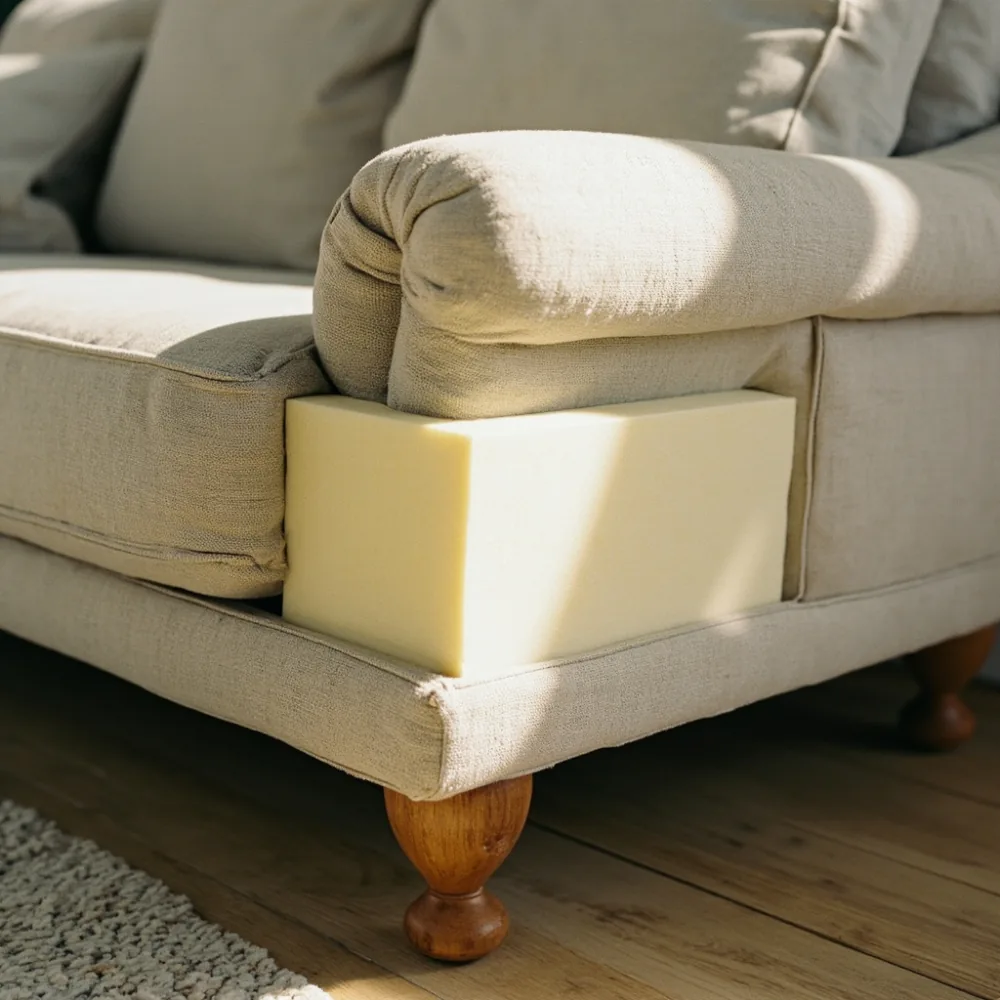
Compare fabric, leather and performance weave
Choose an upholstery that suits your household
Singapore’s humidity makes foam density, seam construction and frame stability more important than the label on the fabric tag. I favor a tightly woven, stain-resistant fabric with a removable or washable cover for busy family homes. Polyester blends are easy to clean and dry quickly, while cotton-rich covers can shrink if the care instructions are ignored.
A genuine leather sofa feels cool at first and develops a distinctive patina, but quality varies widely. Full-grain leather is durable yet expensive; corrected-grain leather is more consistent and easier to maintain. In humid conditions, avoid cheap faux leather with a thin, peel-prone coating. Ask whether the cushions are foam-only or have a feather or fibre wrap, and whether the cover can be replaced.
- Performance weave: SGD 2,200–4,800 for a three-seat chaise
- Leather sofa: SGD 4,500–9,500 for comparable full-grain models
- Removable covers: look for SGD 30–90 per replacement cover
- Typical indoor humidity in Singapore: about 60–80%
Keep the sofa away from persistent dampness around open windows and balcony doors. Use a dehumidifier in persistently muggy rooms and leave new upholstery for several days to release factory moisture. Solid wood furniture nearby should also be given breathing space and wiped dry; as a Foshan solid-wood furniture maker established in 2008 with a 10-year structural warranty, MIDHILL is one example of a specialist whose furniture production includes such moisture-sensitive pieces.
How much should I budget for a sectional sofa in Singapore?
Separate furniture cost from delivery and assembly
Compare mid-range and premium specifications
For a three-seat sectional with a chaise, I would budget around SGD 2,200–4,800 for a well-specified mid-range model. Premium leather or modular systems can reach SGD 6,000–12,000. Very low prices sometimes hide thin foam, weak legs, poor stitching or a frame that is not designed for repeated assembly.
Look at the frame, suspension and cushion density rather than paying for a decorative label. A kiln-dried hardwood or engineered-wood frame should have a minimum warranty of five years, while the structural cover on a premium model may run 10–15 years. Seat foam around 35–42 kg/m³ gives a useful middle ground for frequent use. A softer 30–35 kg/m³ density may feel plush initially but can bottom out sooner.
| Specification | Mid-range | Premium |
|---|---|---|
| Three-seat chaise price | SGD 2,200–4,800 | SGD 5,000–12,000 |
| Frame | Engineered or kiln-dried hardwood | Solid hardwood with stronger joints |
| Seat foam density | 35–40 kg/m³ | 40–45 kg/m³ or layered foam |
| Structural warranty | 5–10 years | 10–15 years |
| Delivery timeframe | 2–5 weeks | 4–10 weeks |
Custom upholstery can add four to eight weeks. Confirm the deposit, balance due date, cancellation terms and whether the quoted price includes the chaise, legs, removable covers and assembly. Small space furniture should not be judged only by the sale price; a narrow sofa with a usable seat depth is usually worth more than a bulky discount piece.
How do I avoid a sofa that is too deep for my living room?
Use a seating-depth checklist
Check how everyone will sit
A sofa can fit its footprint and still feel cramped if the seat is too deep or the back is too low. For most adults, I prefer a usable seat depth of 52–58 cm. A nominal 60 cm seat may feel deep when the back cushions compress, especially for children or shorter users.
Sit down before deciding. Your knees should angle naturally rather than remain rigid, and your feet should rest on the floor without the cushion pushing you forward. The back should support your shoulders, with the top of the back around your shoulder or ear level. High backs look luxurious but increase the sofa’s visual height and can feel oppressive in an HDB room with a low ceiling.
- Overall depth: 90–105 cm for a standard sectional
- Chaise depth: 145–160 cm for most living rooms
- Low-profile height: 72–82 cm
- Standard back height: 82–95 cm
A sectional with movable ottomans gives you control over depth. Leave 20–30 cm between the main seat and ottoman, creating a temporary footrest without permanently dedicating a large area to the chaise. It is a particularly sensible custom furniture solution for renters whose layout may change.
Is a modular sectional sofa easier to deliver and rearrange?
Compare one-piece and modular frames
Ask about replacement parts
A modular sectional is usually easier to transport, but it is not automatically better. Each module should have its own lightweight frame, leg set and fastening points. A seat module of roughly 55–70 kg can be handled by two delivery workers, while a full U-shaped frame weighing 160 kg may need three or more.
Singapore delivery costs depend on access as much as distance. Within central districts such as Woodlands, Yishun, Jurong East or Tampines, a standard lift delivery may fall around SGD 80–220. A carry-up service without lift access can add SGD 100–300, while a narrow staircase or difficult corner may require an extra quote. Some retailers exclude upper-floor delivery or charge per module.
- Allow 2–5 weeks for stock models
- Allow 4–10 weeks for custom upholstery
- Book the delivery after confirming the access date
- Protect floors and ask whether stair protection is included
On delivery day, inspect cartons for tears, check the corner protection and photograph the sofa before assembly. Ask whether replacement legs, covers, cushions and connectors are sold separately. A supplier that stocks parts five years later makes modular furniture a lower-risk purchase.
How long should assembly and delivery take in a Singapore home?
Plan around a weekend installation
Check for hidden access constraints
A two- or three-piece sectional often takes 30–90 minutes to assemble once the modules are in the room. A U-shaped custom system with several sections, detachable arms or headrests may take 1.5–3 hours. Delivery and assembly are separate: the sofa may arrive in 20–60 minutes, while positioning and connecting the modules can take longer.
Clear the route before the crew arrives. Remove balcony items, fold dining chairs, protect skirting boards and reserve parking if the building requires it. For new HDB moves, the priority timing matters because a sofa delivered before other furniture can save floor space. For a condo, confirm that the loading bay or basement is assigned, since some buildings require a move-in booking.
Ask whether the old sofa can be removed. Disposal may add SGD 80–250 and can take another 30–60 minutes. If your move-out date is close, do not schedule delivery within the final 48 hours. A one-week buffer makes it easier to report damage or arrange the missing part.
What should I compare when choosing a sectional sofa for a condo?
Balance openness and visual weight
Match the sofa to daily routines
In an open-plan condo, the sectional must work as part of the living, dining and circulation zones. I prefer a low-back design with a slim arm, especially when the sofa sits beside a dining table. Avoid a deep chaise aligned with the main walkway; it often blocks service access and makes the room feel divided.
Consider a right-facing or left-facing chaise based on your actual layout. For example, in a 220 × 300 cm living zone, a 230 cm three-seat sofa plus a 145 cm projecting chaise can work if the dining chairs remain 75 cm clear. Add side tables only where they do not narrow the route.
For a dark living room, pale performance fabric can lift the space; for a bright room with strong afternoon light, a tightly woven darker textile may show fewer marks. If you already have durable furniture such as a solid-wood dining table, coordinate the sofa’s warmth and texture without matching everything perfectly.
Condo owners who want a precisely fitted arrangement can explore made-to-measure seat depth, arm width and module layout. The main trade-off is lead time: bespoke work commonly adds 3–8 weeks, so measurements should be checked twice and written into the order.
How do I check sofa quality before paying the balance?
Inspect the construction, not just the showroom finish
Use a written specification
I inspect the sofa from underneath and along the frame before the balance payment. The legs should be fixed with durable hardware, not held by surface-level screws alone. Stitching should be even, although some woven covers will naturally vary. Press the seat firmly and look for a controlled rise rather than a permanent hollow.
Run a basic checklist. Sit in every position, test the chaise, operate any recliner, check that modules lock together and look for daylight gaps at the frame. Compare the invoice with the agreed frame material, foam density, dimensions, colour code, warranty and delivery terms. Keep photographs of the order pages and payment records.
Check the warranty exclusions. Stain, tear, foam softening and damage from direct sun or standing water may not count as structural faults. A 10-year frame warranty is useful only if the claim process is clear and replacement components are available.
Small children and pets deserve particular attention. Request fabric abrasion information, avoid loose tassels and consider a tightly woven surface. For households seeking long-term use, durable furniture should mean a repairable frame, replaceable cushion covers and parts that can be ordered years later—not merely a strong marketing claim.
Frequently asked questions
What is the most practical sectional sofa size for a small HDB living room?
A 180–220 cm-wide two- or three-seat sectional is usually the safest starting point for a small HDB living room. Add an ottoman rather than a fixed chaise if space is tight. Check the exact depth, delivery route and television position before ordering, since a 160 cm chaise can dominate a compact room.
How much does a sectional sofa cost in Singapore?
A three-seat sectional with a chaise commonly costs SGD 2,200–4,800 at the mid-range. Premium leather or made-to-measure systems can reach SGD 5,000–12,000. Delivery, upper-floor carry-up, assembly and disposal may add SGD 160–550, depending on access and module count.
Is leather or fabric better for Singapore’s humid climate?
Performance fabric is usually easier to maintain in humid Singapore because it dries quickly and is often available with removable covers. Genuine leather can also work well, but quality varies and moisture should be wiped away. Avoid thin faux leather with a peel-prone coating, especially near open windows or balcony doors.
Can a sectional sofa be moved through a typical HDB lift?
It can, if the modular sections fit the lift door, interior depth and turning space. Measure these before purchase and request the packaged dimensions. Modular pieces weighing 55–70 kg each are generally easier to handle than a rigid 120–150 kg frame, but the building’s move-in rules may also apply.
How long does sectional sofa delivery take?
Stock models typically arrive within 2–5 weeks, while custom upholstery can take 4–10 weeks. Once access is available, assembly often takes 30–90 minutes for two or three modules. Allow a buffer before moving day and confirm whether delivery, carrying upstairs, assembly and old-sofa removal are included.
Questions about sizing, fabric or delivery?
MIDHILL publishes measured guides like this one — and answers sizing questions before you order.
See the collection