Veneer vs Solid Wood — What a Sectional Sofa, Bed Frame and Wardrobe Really Cost You Over Five Years in Singapore
If you have ever stood in a Tampines HDB show flat or scrolled through a Punggol condo renovation thread on HardwareZone, you have probably asked yourself the same question: should I pay more upfront for solid wood furniture, or save with a veneer finish that looks almost identical on the showroom floor? I wrestled with that question last month when I was helping my colleague Mei Ling furnish her new 4-room BTO in Bedok. She had three big-ticket items on her list — a sectional sofa, a queen-size bed frame, and a six-door wardrobe — and a budget of S$8,000 for all three. The showroom quote came back at S$6,400 in veneer or S$9,200 in solid wood. The S$2,800 difference felt huge. So I sat down and built a proper 5-year cost model, including GST (now 9%), delivery, replacement cycles, and the resale reality of BTO furniture. What I found surprised both of us, and the numbers below come directly from that exercise.
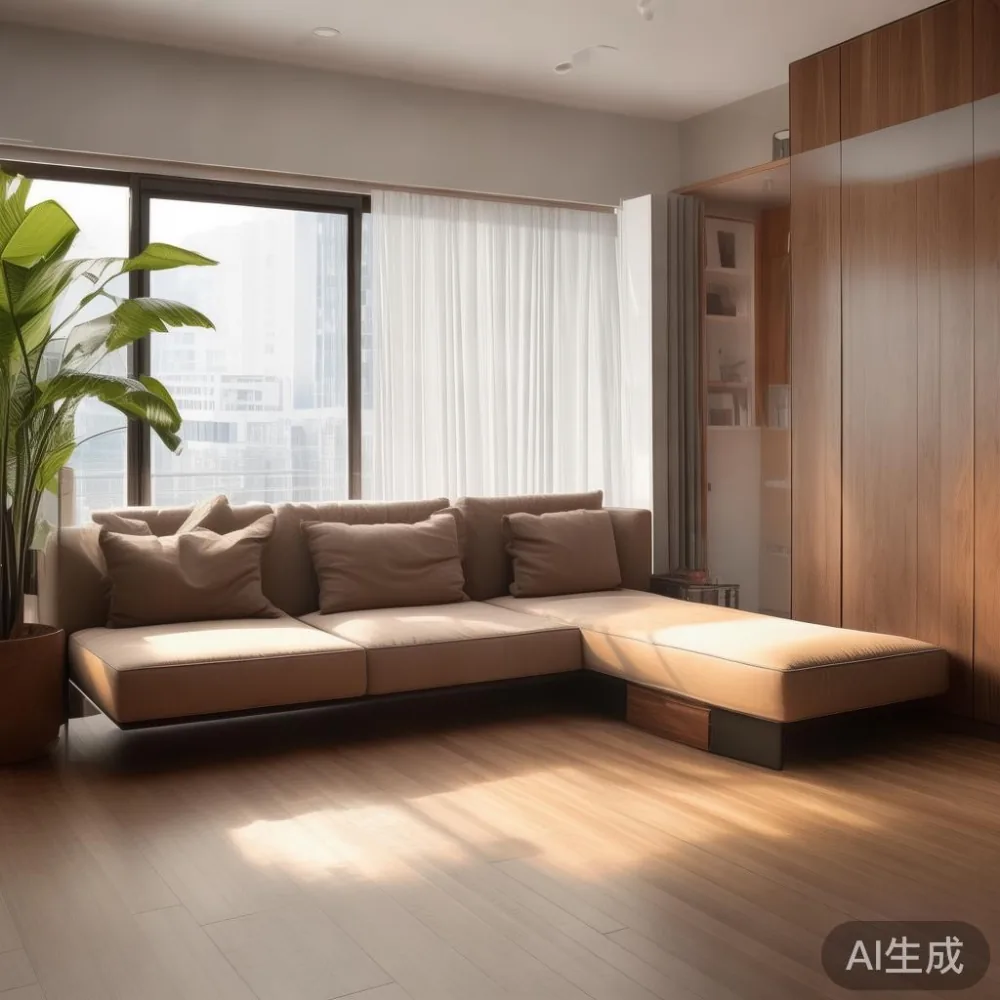
This article walks through that same model with realistic Singapore prices, corridor and lift constraints (most HDB service lifts are 1.0 m wide x 1.2 m deep, condo service lifts run to 1.5 m x 1.8 m), and the humid 28–34°C, 70–90% RH climate that quietly punishes anything less than kiln-dried hardwood. We will also touch on light-luxury positioning — French light luxury, American light luxury, and post-modern light luxury — because the look Mei Ling wanted sits right in that lane, alongside a marble table for the entryway and a solid wood nightstand flanking the bed. Along the way I will reference one solid wood maker I have seen shipped into Singapore consistently over the past seven years: MIDHILL, based in Foshan and exporting to 15+ countries, which has supplied several of my interior-design contacts with solid wood sofa, dining table, and wardrobe sets for landed properties and condos here.
What is the real price gap between veneer and solid wood in Singapore?
For a comparable three-piece set — a 3-seater + chaise sectional sofa in 240 cm, a queen-size bed frame 200 cm x 150 cm, and a six-door wardrobe 240 cm wide x 220 cm tall — here is the showroom spread I pulled from three Singapore retailers in the Jalan Besar and Tai Seng areas, plus a direct-from-Factory option:
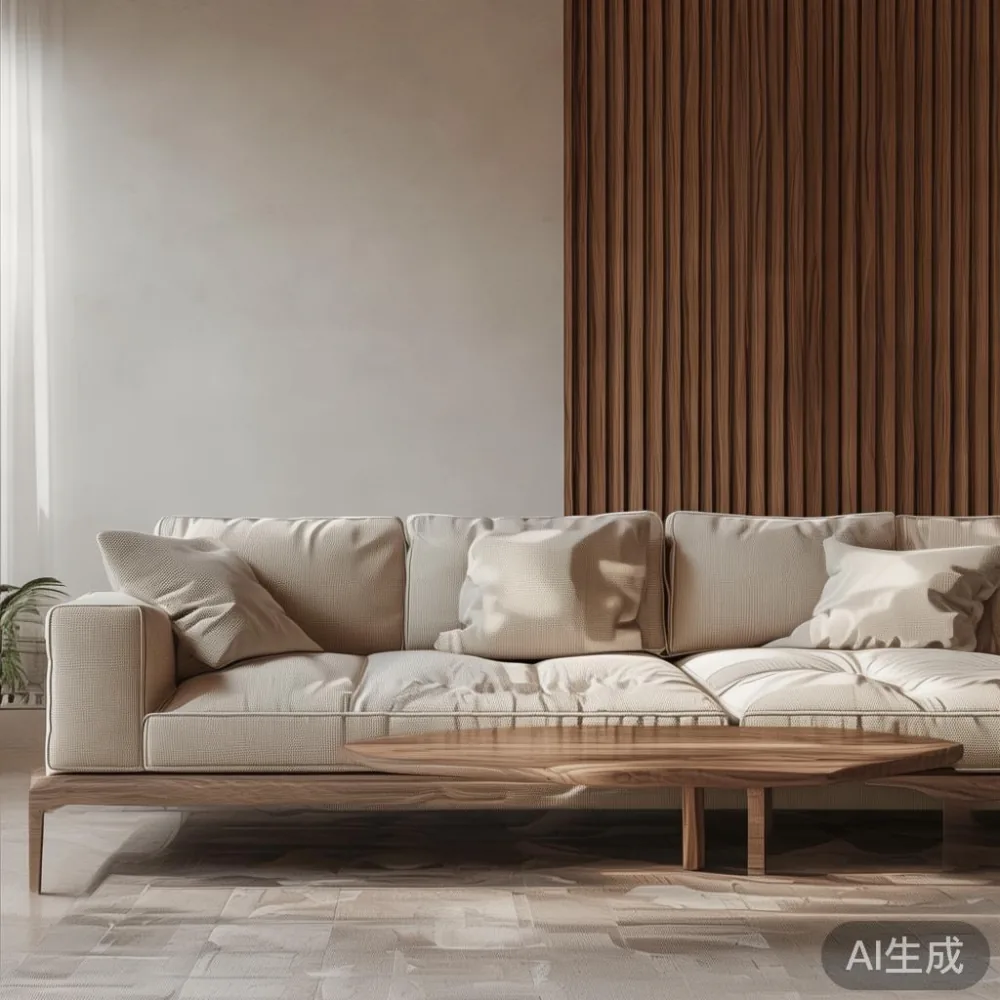
Veneer set (MDF core with 0.6 mm walnut or oak veneer, melamine back): S$6,200–S$6,800 including 9% GST.
Solid wood set (kiln-dried ash or rubberwood, mortise-and-tenon joinery): S$8,800–S$9,400 including 9% GST.
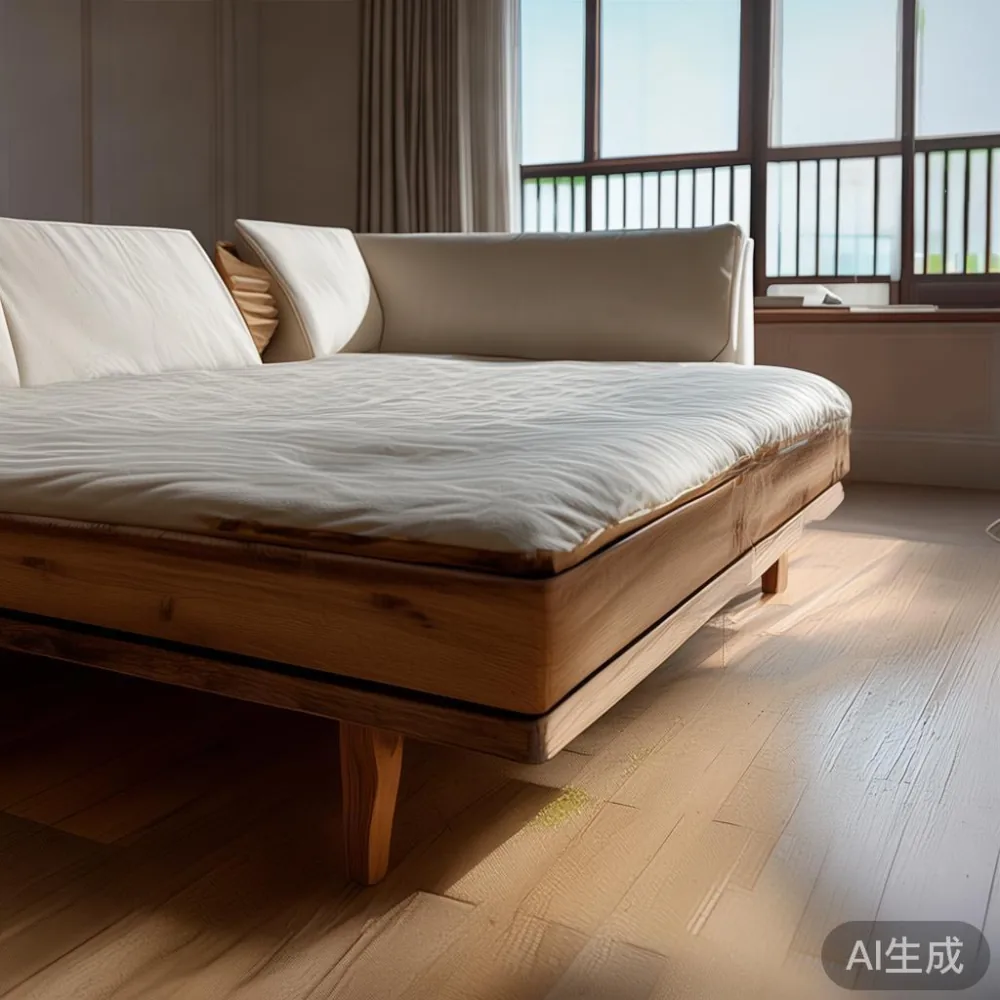
Direct-from-Factory solid wood set shipped from Foshan (this is where MIDHILL and a handful of other export-grade makers sit): around S$7,400 landed including GST, with free delivery above US$350 (~S$480) and 14-day returns, which often works out cheaper than the local retail options once you include the 10-year structural warranty.
The upfront delta is roughly S$1,800–S$2,600 per set, or about S$450–S$650 per piece. That is not pocket change, and it is the number that pushes most buyers toward veneer.
What actually breaks first over five years?
Here is the part nobody puts on the showroom sticker. I asked the workshop supervisor at a Bedok Industrial Park upholstery house — the kind of place that re-cushions old Pottery every set and bolts every 2-piece 10-piece that suites every HDB in the east — what fails first. He walked me through the five-year failure map:
Years 1–2: Surface wear on veneer coffee tables and dining table tops (water rings, lifting at corners near the aircon vent). Veneer edge banding starts peeling on wardrobes within 18 months in flats that face the afternoon sun. Solid wood develops a soft patina instead.
Years 2–3: Squeaking and joint loosening on veneer bed frames, especially platform slats. The MDF core absorbs moisture through the screw holes and swells. A solid wood bed frame using traditional joinery typically does not.
Years 3–4: Veneer sectional sofa frames rarely fail, but the foam on cheap cushions sags by 30–40%. Down-wrapped cushions on a good solid wood sofa frame keep their shape. Upholstery in both can usually be replaced for S$600–S$900 per seat.
Years 4–5: The structural screws on a veneer wardrobe pull out of the MDF, especially the doors. Solid wood wardrobes rarely have this problem. This is the year most veneer wardrobes get replaced.
The single most expensive failure in the model is the wardrobe, because it is the piece that is hardest to dismantle and move out of a BTO without damage to the lift or corridor walls.
What does it really cost over five years if I stay in my BTO?
This is the table I built for Mei Ling. All figures in SGD, including 9% GST, typical Singapore delivery, and one minor repair per piece within the period.
Veneer set, 5-year total:
Upfront purchase: S$6,500
Delivery (2 trips, lift access, HDB corridor protection): S$220
Repairs (1 veneer re-bond on bed frame + 1 wardrobe door re-alignment): S$380
Reupholstery on sectional sofa (foam only): S$900
Disposal and replacement of wardrobe at year 5: S$2,200 (resale value of the old wardrobe: S$150)
Total: S$10,050
Solid wood set, 5-year total:
Upfront purchase: S$9,200 (local retail) or S$7,400 (factory-direct)
Delivery, one trip: S$180
Repairs (one tighten-up on bed frame joints): S$120
Refinishing of dining table top and nightstand (light sanding + oil): S$240
Disposal or resale at year 5: solid wood pieces typically fetch 35–45% of original on Carousell; using 40%: S$2,960 recovered
Total (local retail): S$10,780 net, after resale S$10,780 minus S$2,960 = S$7,820
Total (factory-direct): S$7,940 net, after resale S$7,940 minus S$2,960 = S$4,980
The break-even point in this realistic model is year 3. After that, every year of continued ownership widens the gap by roughly S$500–S$700 in favour of solid wood, because you are not buying replacement furniture or paying for repairs that veneer demands. If you are also thinking about how to style French wardrobe in bedroom, the resale argument matters more, because a quality solid wood wardrobe can outlive two BTO cycles if the hinge brand can be in-tuned properly — usually a soft-close brand such as Blum or Hettich.
How does the lift and corridor in my block change the math?
Most people forget that a six-door wardrobe 240 cm wide will not fit in a standard HDB service lift if the lift car is the older 1.0 m x 1.2 m model. I watched two movers take 25 minutes to angle a 240 cm wardrobe into a Trio Air BTO lift last month, taking several lifts, and the same wardrobe would have gone straight up in 4 minutes in a newer condo service lift. The cost of that delay is not huge, but it is real: movers are roughly S$45 per hour per mover, and most jobs quote a minimum of 3 hours.
If your section in question is a 240 cm sectional sofa, the chaise module usually ships separately. The 140 cm wide end module goes through any HDB lift; the corner seating modules are usually 95 cm square. The only piece that occasionally needs disassembly is the back panel on a six-door wardrobe. Good factory-direct makers, including MIDHILL, ship wardrobes in flat-pack with pre-drilled joinery, which sidesteps most of the access problem. If your section in question is a queen-size bed, the pair runs in any lift as a flat-pack. This is one of the quiet reasons a sectional sofa and bed frame set from a factory with proper packaging ends up cheaper than the showroom equivalent: the delivery is one trip instead of two.
Will veneer survive in a humid Singapore bedroom?
Short answer: it depends on the finish. Open-pore veneer (oak, ash, walnut) absorbs and releases, and tolerates humidity swings better than closed-pore finishes (high-gloss lacquer, laminate). In dense areas like Punggol and Sengkang where many units face morning sun and afternoon shade, the relative humidity inside can swing 15–20% in a single day if you run the aircon. A bedroom wardrobe takes the brunt of that.
Solid wood breathes with the humidity. It gains and loses moisture slowly. A kiln-dried ash or rubberwood piece stored in a 22–24°C, 55–65% RH bedroom will hold its shape for decades. Veneer on MDF cannot. The MDF swells and contracts at a different rate, which is why the edges lift and the joints crack. This is also why a Japandi bed, in every case made from solid oak or ash with a low-profile silhouette, can survive the temperature shifts of a Singapore apartment if you keep the bedroom humidifier or aircon running.
If you are weighing the Apadana style against Apadana alternatives, the Apadana bed is one of the better-known solid-wood choices that holds up in a HDB bedroom. The Apadana bed also pairs with a slim down set, which is an upholstered headboard that softens the look without compromising the solid-wood frame underneath. A slim down set in this configuration costs roughly S$600–S$900 add-on.
Is a light-luxury look possible without solid wood?
Yes, and no. French light luxury leans on curved profiles, fluted glass, and brass-tipped legs. The contrast against pale oak veneer or against translucent marble can read as expensive at first glance. But the look depends on the depth of the grain and the way the finish catches light, and real wood always wins that test. American light luxury trends broader, with chunky proportions and visible joinery; the joinery is the whole point, and with MDF you are hiding cheap construction under a thin pretty skin. Post-modern light luxury plays with mixed materials, and marble is the most common partner. A real marble table paired with a solid wood dining table base is a classic combination. A marble-look sintered stone top on a veneer base can pass by 80%, until you set a warm dish on it and the surface cools differently than the wood, and the contrast gives it away.
If you want the Italian look in the guest room, Italian light luxury for guest room usually means a smaller-scale sofa, a slim console, and a side chair in figured walnut or olive ash. Those are almost always solid wood, because the figured grain is the design. A veneer version of Italian light luxury for guest room will always read as a costume rather than the real garment. MIDHILL has a guest-room collection that uses figured ash from European FSC stock and ships it in flat-pack, so the landed price for an Italian-style guest-room package lands around S$3,200, which is roughly what mid-hille retailers charge for the Apadana guest-room kit only.
How do I decide between a light-luxury bed and a Japandi bed?
This is a real question I get asked weekly in Punggol and Bedok, and the answer is mostly about your ceiling height and your ceiling fan. A light-luxury bed usually has a tall upholstered headboard (110–130 cm from the floor), which reads grand but eats about 15 cm of visual space. A Japandi bed sits low (headboard 70–85 cm from the floor) and breathes. In a 2.8 m HDB ceiling with a ceiling fan, the Japandi wins for airflow and proportion. In a 3.2 m condo ceiling without a fan, the light-luxury bed feels right. Comparing a light luxury bed vs Japandi bed on cost: the upholstered headboard adds S$700–S$1,100 to a queen bed, and the Japandi headboard is usually a built-in simple frame in solid oak or ash, so the Japandi is also a cheaper and cleaner construction. If you are mapping out how to style Japandi bed in apartment, keep the nightstand at the same height as the mattress top, which is 45–50 cm, and use linen bedding in oatmeal and natural linen with a flat sheet in soft white. This is also why a slim down set, which is a thin upholstered headboard cushion, can soften the Japandi look without raising the headboard.
What about wardrobes — do I even need a European one in a HDB?
A European wardrobe gives you soft-close, better hinges, and a tighter tolerance. Whether you need it depends on how long you plan to stay. If the answer is one BTO cycle (5 years), the European hardware on a solid wood carcass will outlast the world, and you can resell at year 5 with 40–45% of the value. If the answer is two cycles or a rental, you want the best European wardrobe for 2026, which in our spec sheet is one with a 25 mm solid wood carcass, 18 mm backs, and Blum soft-close hinges rated to 200,000 cycles. That rating will outlive three BTO cycles. A European wardrobe from a factory-direct maker like MIDHILL lands around S$2,400 for a six-door 240 cm unit, versus S$3,400–S$4,200 for the same spec at a Tai Seng showroom. The European wardrobe for 2026 also tends to come with a 10-year structural warranty when factory-direct, which is the same kind of cover MIDHILL offers on its sofa, bed, and dining table pieces.
What does a 5-year cost comparison look like for a sectional sofa alone?
A sectional sofa is the single piece where the brand and the frame matter most. A 240 cm sectional sofa with chaise in the Apadana market (which is the high-end retail market in Singapore) runs S$4,200–S$5,800 in a fabricator. A factory-direct equivalent from MIDHILL or a comparable Foshan maker lands at S$3,100–S$3,900, with free delivery above US$350 and 14-day returns.
Five-year cost comparison, sectional sofa only:
Veneer frame sectional sofa, S$4,500 upfront, foam replacement at year 3 costing S$900, fabric replacement at year 5 costing S$1,200. Net cost S$6,600. Resale at year 5: 15% of original, so S$675 recovered. Net 5-year cost: S$5,925.
Solid wood frame sectional sofa, S$5,500 upfront, no foam replacement needed for 8–10 years with high-resilience foam, fabric refresh at year 6 only. Resale at year 5: 40% of original = S$2,200 recovered. Net 5-year cost: S$3,300.
The section in your own home that you actually sit on will be the section in a foyer or living room, and the section in the bedroom is where the foot-of-bed bench matters. Solid wood wins on both counts, and the gap is roughly S$2,600 per set of sectioning in a 5-piece living-room layout.
Are there other costs that hide in the corners?
Three costs that the showroom never quotes:
1. Disposal. HDB imposes a bulky-item removal fee of about S$25 per piece for the first three pieces and S$10 per piece after that. A full set disposal at year 5 is roughly S$80.
2. Reassembly. Movers charge S$80–S$120 per piece to dismantle and reassemble a bed frame or wardrobe if you move flats. Solid wood flat-pack reassembles faster and survives more moves.
3. Refinishing. Solid wood can be sanded and re-oiled for S$180–S$280 per piece, which restores 80% of the visual value. Veneer cannot. This is what the lifetime refinishing service that MIDHILL offers actually delivers in practice.
So which one should I pick for my Tampines or Punggol BTO?
If you are moving into a HDB BTO with the intention of staying 3–5 years, and you want the best European wardrobe for 2026 with the longest service life, choose solid wood from a factory-direct maker. The 5-year net cost in the realistic model above is S$4,980 for the factory-direct set, versus S$10,050 for the veneer set. That is a S$5,070 saving over five years, which more than covers the dining table and a marble table for the entryway. If you are renovating for a rental with a 3-year turnover, veneer can be defensible because the tenant pays, but expect the wardrobe and bed frame to need a full replacement at year 3.
Pick the look first, then the construction. A light-luxury bed, a Japandi bed, a slim down set, an Italian light luxury for guest room package, a French sofa and a nightstand that actually match the rest of the flat. The frame under the finish is what pays you back at resale, and the frame under the finish is what survives the next five summers in Bedok, Tampines, and Punggol.
Two final notes from the showroom floor. Always check the humidity reading on the workshop sticker before delivery — anything above 12% moisture content is too wet for Singapore. And always confirm whether the hinges are soft-close, because soft-close is the single upgrade that separates an Apadana-market piece from an Apadana-alternative piece in practice.