Solid Wood Furniture in Singapore: Humidity Impact
Singapore’s warm, humid climate can make solid wood furniture move, swell, check, and lose its surface finish over time. The effects are especially noticeable in HDB flats and condos in Tampines, Bedok, and Punggol, where compact living spaces often have limited airflow and furniture sits close to walls, air-conditioner vents, windows, and lift lobbies.
This guide explains how humidity affects a solid wood sofa, bed frame, dining table, wardrobe, and nightstand, with practical measurements for Singapore homes. It also covers delivery planning through narrow corridors and lifts, plus the long-term care behind MIDHILL’s 10-year structural warranty and lifetime refinishing service.
What Singapore’s humidity does to solid wood furniture
Wood is a hygroscopic material: it absorbs moisture when the surrounding air is humid and releases moisture when the air becomes drier. Relative humidity means the amount of water vapour in the air compared with the maximum the air can hold at that temperature. Singapore commonly experiences relative humidity above 70% during wet periods, and the daily range can be wide enough to stress furniture placed near an air-conditioned room.
For solid timber, movement is easiest to understand as a change in dimensions. A 180 cm-long solid oak dining table may expand by roughly 1–3 mm across its grain as moisture changes. A solid wood bed frame can develop small gaps where components meet, while a wardrobe door may sit less firmly against its carcass. These changes do not automatically indicate defective construction, but persistent movement can loosen joints or create a rough surface if the timber is repeatedly saturated and dried.
Humidity also affects finishes. Water-based coatings, oils, waxes, and lacquers behave differently, yet all can look dull, hazy, sticky, or uneven when moisture collects on the surface. Stone surfaces have their own considerations: a marble table is not affected by wood movement, but acidic cleaners and moisture trapped against the base can dull the stone or affect adhesives used in furniture assembly.
The goal is not to eliminate every seasonal movement. It is to keep changes gradual. In a Singapore bedroom maintained near 50–60% relative humidity, a solid wood bed frame has steadier conditions than one positioned beside a frequently opened bathroom door.
How much humidity is comfortable for wood furniture?
A practical indoor target of 45–65% relative humidity suits most wooden furniture and reduces unnecessary expansion. Short periods above 65% are normal in Singapore. Prolonged exposure above 70–75%, combined with poor ventilation, deserves more attention.
A affordable hygrometer placed beside a wardrobe or dining table gives a better reading than a weather app because sensors measure the room where the furniture actually stands. Keep the display at least 30 cm away from an air-conditioner outlet, because direct cold airflow can create rapid local changes rather than balanced room conditions. Check it at about 9 a.m. and 9 p.m. for 7 days, then record the highest and lowest readings.
For residents in Tampines or Punggol HDB flats, a bedroom humidity above 70% for several days may suggest running the air-conditioner in a closed room before switching it off. Dehumidifiers can help in larger spaces; a unit rated for a 20–30 m² room is more appropriate for one open bedroom than for an entire flat. No dehumidifier should be placed directly beneath a solid wood bed frame, as restricted airflow can trap moisture around the base.
Wipe furniture with a soft cloth dampened with water, then dry it immediately. Do not use a soaked cloth, steam cleaner, or household glass cleaner on lacquered or oiled timber. A quick cleaning should take about 2 minutes and leave the surface almost dry rather than visibly wet.
How should I protect a solid wood sofa in a humid HDB flat?
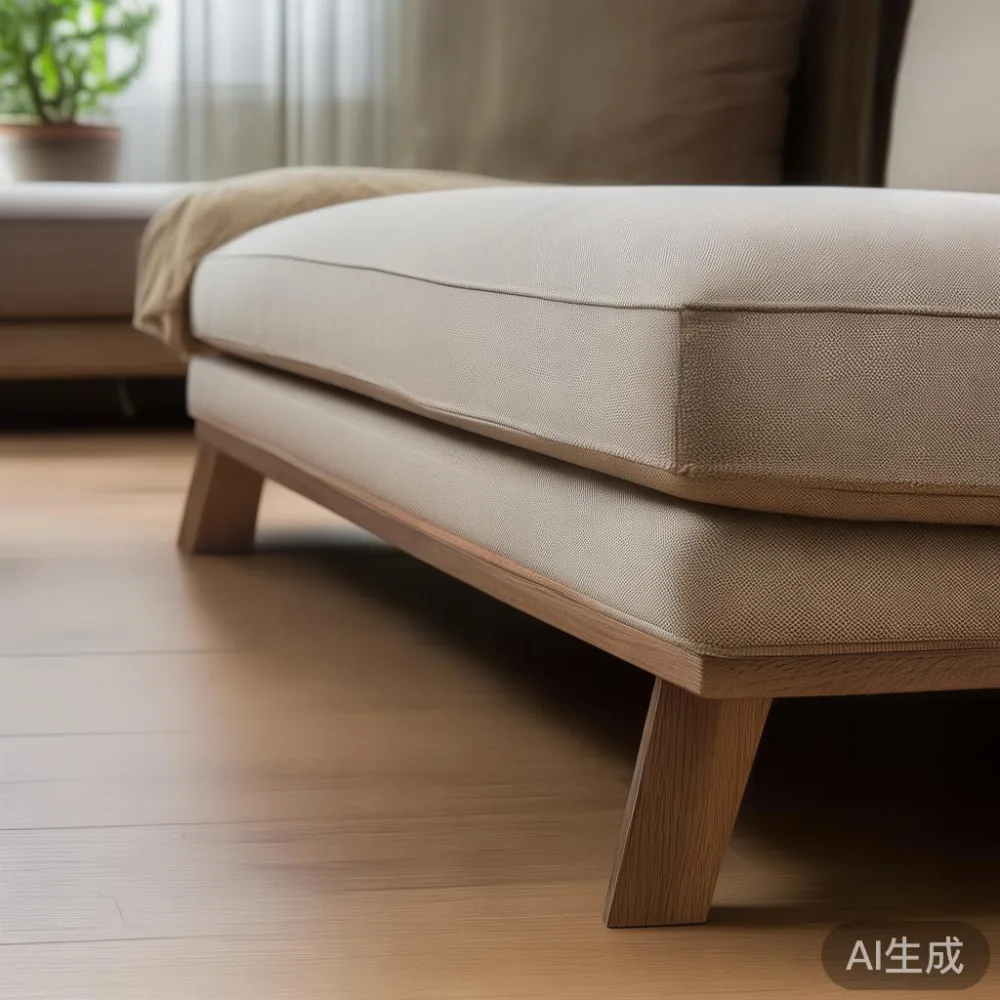
A sectional sofa gives Singapore households useful zoning: one section can face a television, while another can serve as a reading area. The timber base, armrests, legs, and internal frame still need moisture protection, especially if the sofa sits against an external wall in Bedok or near a balcony door.
Leave a 5–10 cm gap between the wall and the rear of the sectional sofa where space allows. This improves airflow and allows the back edge to dry if condensation forms. If the wall is frequently cold or damp, place a thin moisture barrier behind the frame and check it every 3 months for lifting or mould.
Choose a protected position away from direct air-conditioning output. An outlet blowing across one side of the sofa can dry that area faster than the other, encouraging uneven movement. Position the sectional sofa so each major timber section receives similar airflow.
For upholstery, rotate loose cushions every 2–4 weeks and lift them to expose the seat deck. Use a vacuum with a brush attachment at low suction to remove dust and grit, keeping the nozzle about 2 cm above the fabric. Follow the care instructions for the specific cover; cotton and linen blends generally tolerate controlled moisture better than untreated velvet.
Singapore shoppers comparing options for sale light luxury furniture should examine the timber specification, joinery, finish, and after-sales terms rather than relying on style labels alone. French light luxury, American light luxury, and post-modern light luxury can all work in an apartment, but a pale sectional sofa beside a sun-facing window will show dust and damp-related marks sooner than a darker, textured piece in a shaded room.
Can an apartment with narrow corridors and lifts damage furniture?
Furniture movement is more likely to cause trouble than delivery damage, but planning still matters in Singapore’s high-rise buildings. Before ordering a solid wood sofa or bed frame, measure the full route: the HDB car-park ramp, entrance, corridor turns, staircase, lift car, and flat entrance.
A common HDB lift car measures around 90–140 cm deep and 100–140 cm wide, with a door opening of roughly 80–90 cm. The usable height is often about 210–220 cm, though older blocks vary. A sectional sofa delivered as separate modules is often more practical than one rigid unit. Modules of 70–100 cm wide can work through a 90 cm lift opening more easily and can be carried through by 2 people.
Protect the timber with moving blankets at least 5 mm thick, corner guards, and 2–3 cm foam padding around shaped parts. Lift the frame rather than dragging it, and use furniture straps rated for at least 150 kg for a joined component. Record the corridor width at the narrowest point. If a module passes with only 2 cm clearance, it is technically manageable, but a door swing may change the effective angle.
For a dining table, measure it diagonally as well as by width and length. A 200 cm rectangular table may fit into a lift diagonally but still be difficult to rotate around a landing. MIDHILL can confirm packed dimensions before dispatch, and delivery normally takes about 7–14 business days after production in Foshan, with extra transit time for peak periods. Local delivery, GST, and access details should be confirmed before the vehicle leaves.
How should I choose and care for a solid wood bed frame?
When learning how to style American bed in apartment layouts, start with humidity rather than decoration. A solid wood bed frame should stand on level floor pads, not directly on carpet that traps moisture. In a compact HDB bedroom, leave 5 cm behind the headboard and 3–5 cm along exposed sides where practical.
Slatted bases provide better airflow than solid bases and suit Singapore’s ventilated bedroom conditions. Check that slats sit within their supports and that the frame has suitable centre support, particularly for a queen bed carrying 2 adults. Avoid pushing the frame against a cold external wall.
Buyers looking for the best American bed for 2026 will find that styling trends matter less than solid timber, sound joinery, ventilation, and warranty coverage. A warm walnut finish can pair with cream bedding and simple curtains, while a pale oak frame suits a bright room. French provincial styling introduces carved details and softer proportions; post-modern light luxury often uses clean planes and restrained contrast.
For anyone weighing Japanese bed vs French provincial bed, the practical distinction is clear. Japanese floor-level beds usually have a lower profile, while French provincial beds often use a raised frame and shaped headboard. In humid Singapore conditions, either design needs airflow and stable floor contact. A French provincial bed with a solid wood frame may need more attention around detailed joints because more exposed surfaces complicate drying.
Dust the headboard and rails every 2 weeks. If the finish dulls, use a manufacturer-approved wood-care product rather than household polish. Minor scratches can often be treated through MIDHILL’s lifetime refinishing service, subject to the applicable terms and assessment.
What care do dining tables, wardrobes, and nightstands need?
A solid wood dining table should be kept away from sliding doors, kitchen steam, and tablecloths that trap moisture against the surface. Use coasters and trivets, remove spills within 5 minutes, and refresh the finish every 12–24 months according to wear. A table that receives daily meals may need inspection sooner than a formal side table.
For a wardrobe, check the top and rear panels for dust every 3 months because warm air rises and condensation can remain near upper corners. Interior drawers should slide freely and not be packed tightly against the sides. A 60 cm-wide wardrobe in an HDB bedroom may require 3–5 cm of installation clearance, including room for hinges and minor timber movement.
An Italian light luxury nightstand may use marble, lacquer, or metal accents, so its care instructions should match every material. Keep bottles and humidifiers on a tray, maintain 8–10 cm of space from the wall, and check underneath for dampness every month. A marble table needs a neutral, pH-balanced cleaner; lemon and vinegar can damage some stone finishes.
Revalidate the timber specification before purchase. A product described as solid wood sofa, bed frame, dining table, wardrobe, or nightstand should state which parts are solid timber, which are plywood or engineered board, and which are veneer. Transparent information helps buyers compare moisture performance instead of assuming every visible surface has the same construction.
How can I test humidity and inspect a new furniture delivery?
Last month I visited a colleague in a Tampines condo and tested a solid oak dining table beside a floor-to-ceiling window. The room reading moved from 66% at 9 a.m. to 74% at 3 p.m., while the table’s underside remained several degrees cooler than the room. A thin digital hygrometer placed beneath the table read 78% after 4 hours.
That test confirmed why a 5 cm wall gap and occasional ventilation matter. We moved the table 12 cm away from the glass, used a coaster under a cold metal water bottle, and checked the top near the window with a moisture meter. The reading returned to the room baseline after the table was moved and the surface dried. The table itself did not crack, but the experiment showed how a localized cold spot can keep one edge damp for hours.
For any delivery, inspect the packaging before signing. Look for crushed corners, water marks, separated joints, scratches, and finish transfer beneath the wrapping. Photograph the pallet, the lift, and each marked piece. Furniture should not be accepted into a damp stairwell or stored against a wet wall.
Allow solid wood furniture to acclimatise in its final room for about 7–14 days. Remove wrapping gradually because trapped packaging can slow moisture equalisation. Keep away from wet laundry, new paint, and dripping air-conditioner pipes. After 14 days, compare a hygrometer near the furniture with one in the centre of the room.
What warranty, delivery, and service details should Singapore buyers confirm?
Confirm the Singapore-facing price in SGD, including GST and delivery charges, before placing an order. MIDHILL has operated since 2008, exports to more than 15 countries, and offers a 10-year structural warranty and lifetime refinishing. These terms provide a clearer basis for comparison than broad style descriptions alone.
Ask what the structural warranty covers, how claims are assessed, and which finish or component issues may be excluded. For refinishing, confirm whether the service includes collection, repair, or refinishing, and whether return freight is charged. Reviewing terms before purchase prevents confusion, especially for a sectional sofa with multiple timber and upholstery components.
Delivery usually takes about 7–14 business days after the order is confirmed and ready, while made-to-order pieces can require about 4–8 weeks. The supplier should provide packed dimensions, the number of cartons, lift-access details, and an estimated delivery window. Singapore’s 14-day return policy also deserves careful review, particularly for made-to-order furniture, because some custom dimensions and finishes may be excluded.
MIDHILL offers free shipping on orders above US$350, but Singapore buyers should request the actual SGD charge and whether free shipping applies to the destination or only to the international leg. Orders over US$350 should still have a clear local logistics arrangement.
What is the best humidity-control routine for Southeast Asian homes?
A stable routine is simpler than constant intervention. Keep indoor relative humidity around 45–65%, use a hygrometer in occupied rooms, clean spills immediately, and inspect hidden surfaces every 3 months. Ventilate after showers, run the air-conditioner to remove moisture before switching it off, and keep furniture at least 5 cm from cold external walls where possible.
Do not repeatedly rub a swollen surface with abrasive cleaners. Let the timber respond to balanced conditions, and contact the maker if movement creates loose joints, finish failure, or a major dimensional change. Good lighting is important too: position a solid wood sofa or bed frame so one side is not repeatedly heated by direct afternoon sun.
Light-luxury design works best when proportion, material honesty, and climate control are considered together. French light luxury can suit a classic HDB interior with restrained curves; American light luxury often emphasises generous comfort; post-modern light luxury can simplify a compact condo with clean geometry. The timber still matters, regardless of the design language.
Singapore’s humidity does not make solid wood furniture impractical. It does reward careful placement, measured care, and realistic expectations. With the right room preparation, an openable wardrobe door, a stable dining table, and a well-supported sectional sofa, quality solid wood furniture can remain a long-term part of the home rather than a short-lived showroom piece.