Sectional Sofa Buying Guide in Singapore
A sectional sofa can look generous in a showroom and become an awkward obstacle in a Singapore home. The sofa may fit the living room floor plan but block the television, reduce walking space, or arrive in modules that cannot clear the lift lobby and corridor. Buying without checking access is like choosing a bed frame, dining table, wardrobe, or nightstand without measuring the route into the bedroom. This guide explains how to verify comfort, dimensions, access, and ownership costs before a sectional sofa enters your HDB flat or condo in Tampines, Bedok, Punggol, or elsewhere.
MIDHILL makes solid wood furniture with practical support for customers who need more than a styled photograph: a 10-year structural warranty, lifetime refinishing, free shipping over US$350, and 14-day returns. Those policies matter after purchase, but they cannot substitute for careful measurements at home.
How do you measure a sectional sofa before ordering?
Start with the space, not the product catalogue. Measure the living room at 3 points: the longest usable wall, the narrowest route from the door to the sofa position, and the area needed to open the sectional. Use a tape measure rather than a phone estimate. Record wall length, room width, ceiling height, door width, corridor width, lift car dimensions, and the distance between fixed items such as air-conditioner units and television consoles.
A sectional sofa should leave at least 90 cm for a main walkway and about 60 cm in front of a seat for comfortable movement. These are usable planning allowances, not universal building rules. If a sectional is 320 cm wide and 180 cm deep, its footprint is 5.76 square metres, excluding the space occupied by the chaise extension. Measure every module separately as well as the assembled arrangement. A piece may fit diagonally but still be impossible to turn through a corridor corner.
Draw the room to scale on graph paper. Mark doors, windows, sockets, and television points. Place the sectional in its intended orientation and test both walking and cleaning access. A 30 cm gap behind the sofa can help cable management, while a 10 cm gap beside an armrest may be enough for a wall but not enough for a person to pass.
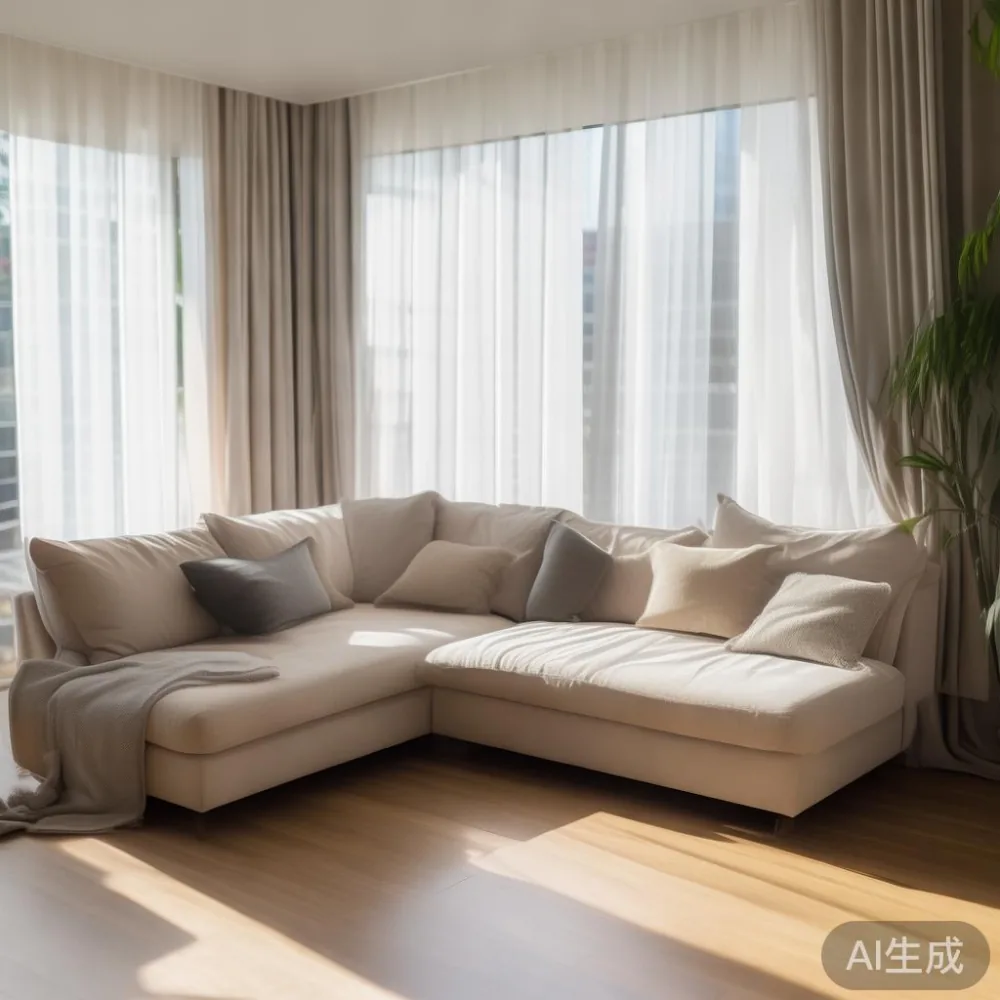
For compact HDB interiors, compare a two-piece sectional with separate chairs rather than assuming a larger model is more comfortable. If the living room is only 4.2 by 3.6 metres, a 300 cm sectional may occupy most of one wall. A 230 cm sofa with two movable ottomans can provide flexibility, provided the ottomans can be moved without scraping the floor.
What dimensions should I check against my HDB lift and corridor?
Ask the seller for the packed dimensions of every section, including the carton, rather than only the finished sofa. A showroom measurement of 120 by 90 cm may become a package of 128 by 98 by 48 cm. Record the lift opening width, lift car depth, lift car height, corridor width, and any turns. Many HDB blocks have a lift door around 90 cm wide, but internal car sizes vary, and refurbishment work can affect the landing or corridor.
For a straight corridor, leave roughly 5 to 10 cm of clearance around a package. At a 90-degree turn, the diagonal of the longest carton matters more than its width. Do not assume a rigid sofa frame can be tilted through a doorway; upholstery, joints, and connectors may be damaged if the package is forced or twisted.
Condo access can involve a second set of doors, a service corridor, a loading bay, or a lift reservation. Confirm whether the building allows furniture deliveries on the chosen day and whether the lift must be booked. A useful test is to compare the smallest carton length with the lift car diagonal. If it does not fit, ask whether the sectional can be delivered in more cartons or assembled inside the flat.
For deliveries to Singapore addresses, expect a practical delivery window of 7 to 14 days for stocked items, but allow 14 to 30 days for made-to-order upholstery or remote routes. Always get the delivery estimate in writing. MIDHILL can discuss the route details before dispatch, yet the buyer remains responsible for checking the building’s access conditions.
Can I actually sit on the sofa comfortably?
A sectional sofa is a seating product, so sit before committing. Check seat height, seat depth, back angle, arm height, and the position of the chaise. A standard seat height of 42 to 45 cm suits many adults, while a 38 to 40 cm seat is easier for shorter users. A seat depth of 55 to 60 cm allows upright sitting without the occupant sliding forward. A deeper seat may feel relaxed but can make standing up harder.
Sit for at least 10 minutes, not 30 seconds. Your knees should remain naturally supported, your shoulders should not be forced forward, and your feet should rest near the floor. Test the chaise with a 170 cm adult and a taller person if household members differ in height. A chaise that supports the legs of one person may leave the other person’s feet hanging.
Press the seat cushions, inspect the foam recovery, and test the back cushions by leaning back. Lift one cushion if the seller permits it. Check whether the frame is kiln-dried solid wood, plywood, or a mixed construction, and ask for the exact material used beneath the upholstery. A solid wood sofa should be described precisely; solid timber in the visible frame does not automatically mean every internal component is solid wood.
Upholstery durability also affects daily use. Request the fabric composition and rub count where available. A 30,000-rub rating is more appropriate for everyday residential use than a thin decorative weave, while 50,000 rubs or more suits heavier use. Removable covers, washable cushions, and replaceable cushion inserts can extend the life of the sectional sofa. A pet household should test for claw resistance and keep a spare fabric swatch.
How do I know whether the sofa will suit my living room?
Choose the sectional sofa by proportion, circulation, and visual weight. A long, low profile can make a modest HDB living room feel wider, while a deep, high-backed arrangement can make the same room feel enclosed. French light luxury styling often uses pale upholstery, carved details, and elegant profiles; American light luxury tends toward generous cushions, clean lines, and relaxed comfort; post-modern light luxury can pair restrained forms with warmer wood accents. The named style should support the room, not dictate it.
Consider the wood finish alongside your existing furniture. A solid wood sofa with walnut-toned legs can coordinate with a dining table, while a pale ash frame may suit a compact bedroom. If you are comparing other furniture, a European light luxury coffee table should also respect the 60 cm circulation gap, and any marble table needs a stable base that does not reduce the sofa’s usable clearance. The same principle applies when choosing how to choose Japanese wardrobe for a bedroom or how to choose European light luxury wardrobe for a condo: finished dimensions and access must match the room.
Lighting influences perception. Place the sectional near a window without exposing the fabric to direct afternoon sun. Singapore’s humidity around 75 to 90% can encourage mould or mildew if damp cushions remain trapped. Look for breathable upholstery, ventilation gaps, and removable covers. For a new upholstered piece, allow approximately 48 to 72 hours for any packaging moisture to dissipate in a ventilated room.
Think about the room’s purpose too. A sectional that consumes the television viewing area may be attractive but frustrating if someone must cross it to reach a balcony door. A Vintage for small living room design should prioritise a clear central path, not merely a nostalgic appearance. For a 5 by 4 metre room, a 240 to 280 cm sectional usually offers more practical freedom than a 330 cm arrangement.
What should I ask about the frame, warranty, and delivery?
Ask for a written specification: frame timber, joinery, suspension type, foam density, cover material, dimensions, carton sizes, and weight. A middle-density seat foam around 35 to 45 kg/m³ is a reasonable residential reference, but hand-feel and construction still matter. For a solid wood sofa, check whether corner joints are dowelled, screwed, or joined with metal brackets. A 10-year structural warranty should state what it covers, what exclusions apply, and how a claim is processed.
MIDHILL’s lifetime refinishing service is relevant for a solid wood frame because scratches and colour changes can occur over years. Confirm whether refinishing applies to selected wood surfaces and whether the customer arranges collection. Ask about upholstery wear, foam compression, and accidental damage separately. Do not treat a structural warranty as protection for every fabric stain.
Check the final price in SGD. Include GST, delivery, lift booking, assembly, and any removal of packaging. Singapore’s standard GST is 9%, so a listed price of SGD 3,200 before GST would be SGD 3,488 after tax. A sectional sofa may range from about SGD 1,800 for a simpler imported model to SGD 8,000 or more for a tailored solid wood and premium-upholstery configuration. Compare like with like; an unusually low quotation may omit delivery or use different frame materials.
For clarity, you can review MIDHILL’s range at www.midhill.co and request dimension drawings before placing an order. MIDHILL has exported to more than 15 countries since 2008, which is useful evidence of manufacturing experience, but local fit still depends on the actual building and delivery route.
Can the sofa be returned if it does not fit or feel right?
Look for a return policy that provides enough time to assess the sectional sofa indoors. MIDHILL offers a 14-day return period, allowing a buyer to check seating comfort and placement against the measured room. Read the condition requirements: the sofa may need to be unused, unwashed, and returned in its original packaging. Custom upholstery, modified dimensions, or certain clearance items may have different terms.
Before accepting delivery, photograph the cartons, labels, and sofa from several angles. Inspect corners, seams, cushions, and frame components while the delivery team is present. If a package is visibly damaged, note it on the delivery record before signing. Allow up to 2 hours for a sectional to be assembled and positioned, then use it for several days before judging the seat depth or chaise angle.
Also consider whether the return journey has the same access restrictions as the delivery. A sofa that entered through a wide lift may not leave easily if a new carton has been compressed. Measure the return route again and confirm any restocking charge in SGD. A 14-day window is more useful when the policy explicitly explains how a large item is collected.
What questions should I ask before paying?
Ask: “What are the exact dimensions of each sectional module?” “What are the packed carton dimensions and total weight?” “Will the delivery team carry the sofa into my unit and place it?” “What happens if the lift is too small?” “Can I test the seat and chaise in person?” “Which parts are covered by the 10-year structural warranty?” “Is GST, delivery, assembly, and returns included?” These are 7 questions, and each should receive a written answer.
The final check is simple: the sofa should fit the room, fit the route, and support the way people sit. For a bedroom, the same measurement discipline can help when asking is Italian light luxury bed worth it, or when evaluating a bed frame, dining table, wardrobe, or nightstand. The material matters, the style matters, and the service promise matters; however, access and comfort determine whether the furniture works every day.
Take 15 minutes with a tape measure, photograph the lift and corridor, request a dimension drawing, and test the seat before paying. That small investment can prevent a sectional sofa from becoming permanent furniture that nobody can sit on.